
- Stone14
- Reports3
-radiant-white-sapphire-1.5900-cts-s19210-1.jpg?d=200x200&v=20241213092447)
-radiant-white-sapphire-1.5900-cts-s19210-lifestyleimage-1.jpg?d=200x200&v=20241218224754)
-radiant-white-sapphire-1.5900-cts-s19210-lifestyleimage-2.jpg?d=200x200&v=20241218224754)
-radiant-white-sapphire-1.5900-cts-s19210-lifestyleimage-3.jpg?d=200x200&v=20241218224754)


-radiant-white-sapphire-1.5900-cts-s19210-1.jpg?d=750x750&s=nsc&v=20241213092447)
-radiant-white-sapphire-1.5900-cts-s19210-lifestyleimage-1.jpg?d=750x750&s=nsc&v=20241218224754)
-radiant-white-sapphire-1.5900-cts-s19210-lifestyleimage-2.jpg?d=750x750&s=nsc&v=20241218224754)
-radiant-white-sapphire-1.5900-cts-s19210-lifestyleimage-3.jpg?d=750x750&s=nsc&v=20241218224754)

1.59 Ct. White Sapphire from Ceylon (Sri Lanka)
This loose stone is available to ship now
Item ID: | S19210 |
|---|---|
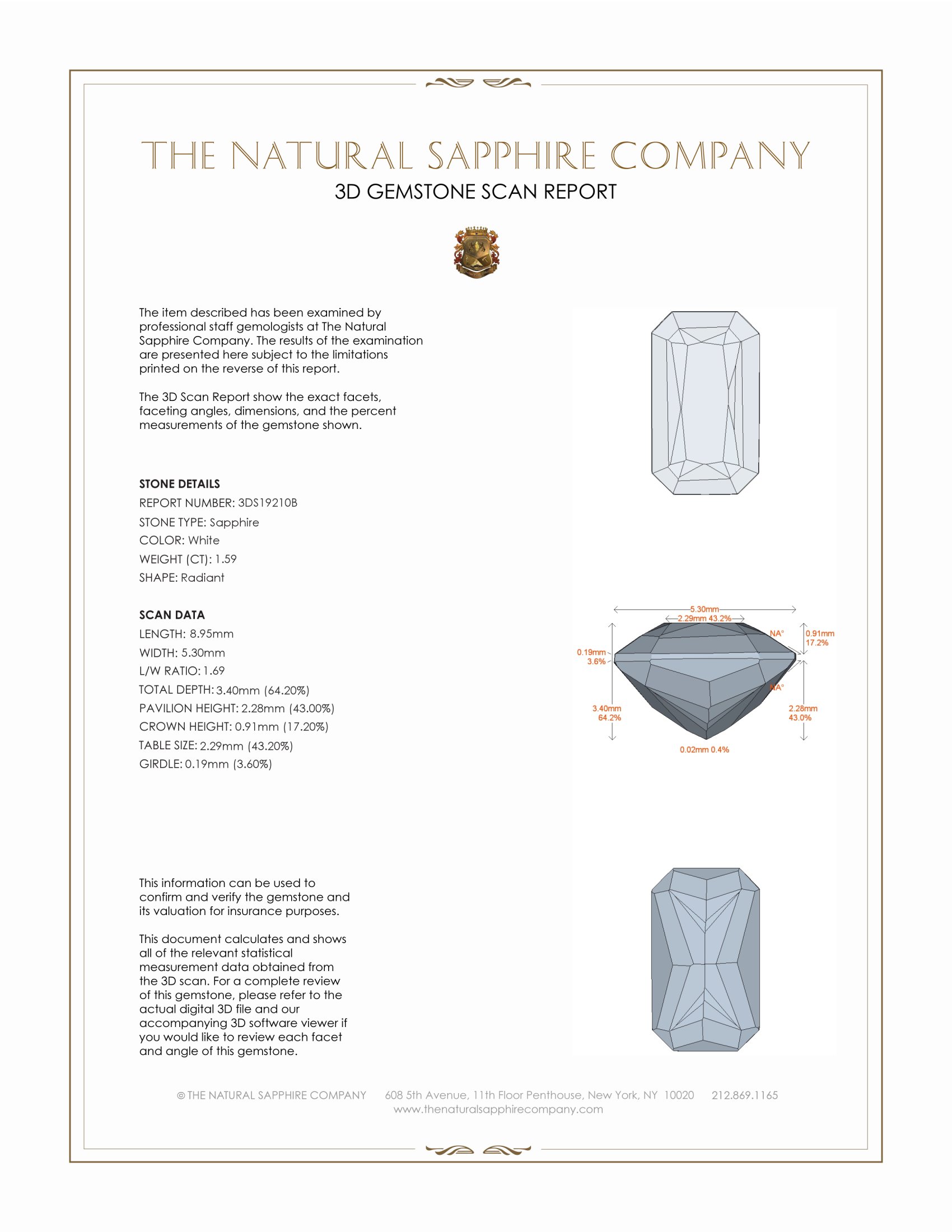
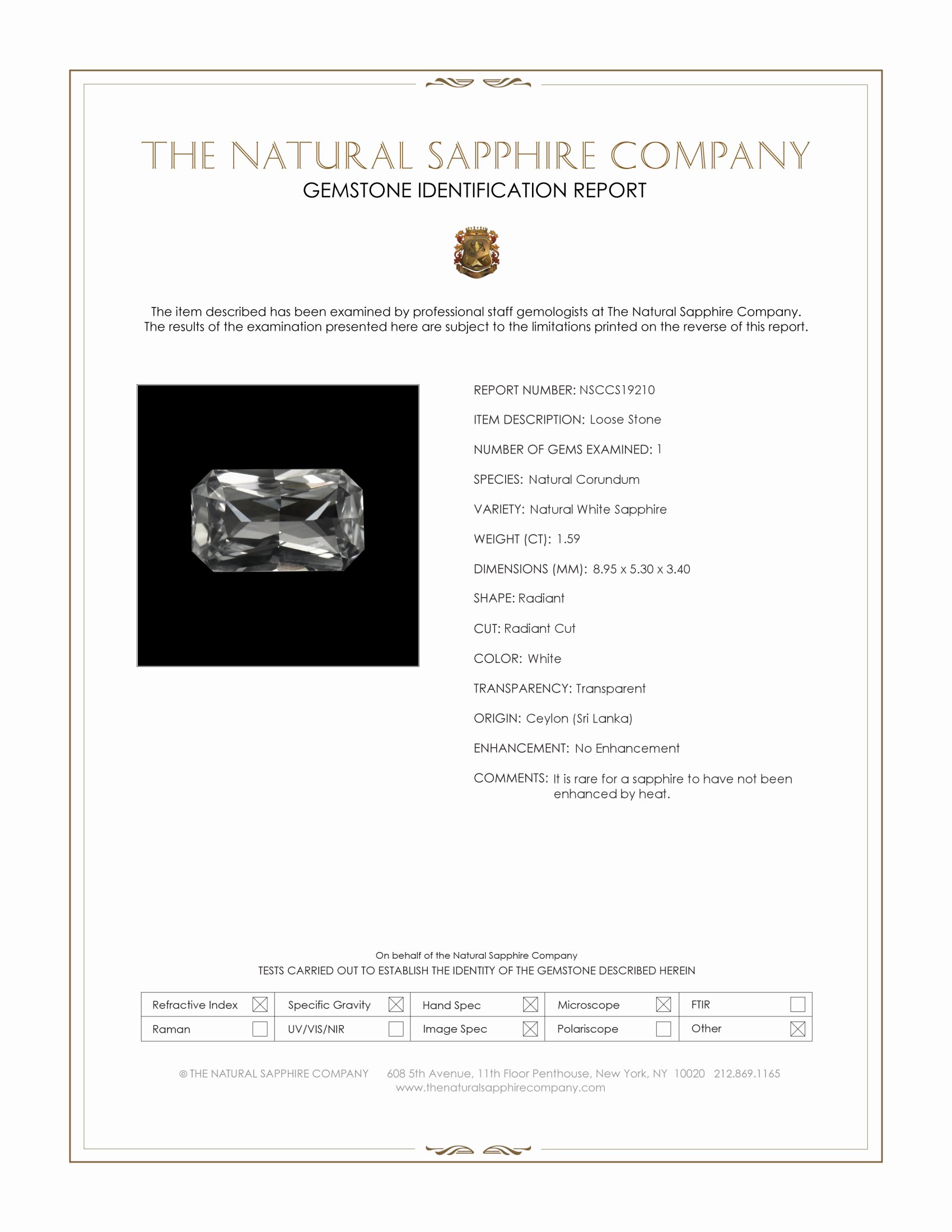
Dimensions (MM): help | Length: 8.95 Width: 5.3 Height: 3.4 |
Weight: | 1.59 Ct. |
Color: help | White |
Color intensity: help | Near Colorless |
Clarity: help | Very Slightly Included |
Shape: help | Radiant |
Cut: | Radiant Cut |
Cutting style: | Faceted |
Enhancements: help | No Enhancement |
Origin: help | Ceylon (Sri Lanka) |
Per carat price: help | $578 |
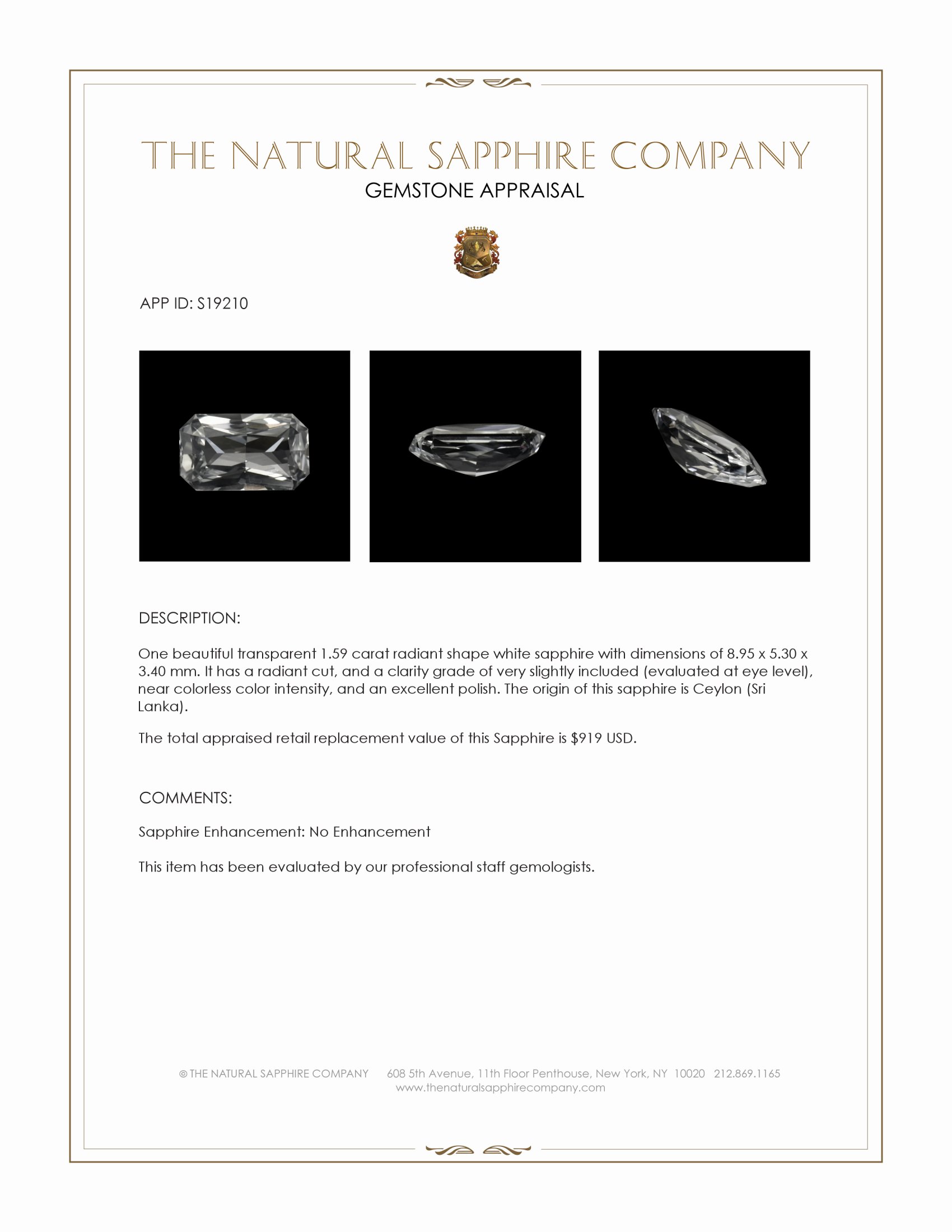
This specimen is a transparent 1.59 carat radiant shape white sapphire, with calibrated dimensions of 8.95 by 5.30 by 3.40 millimeters. The pavilion and crown proportions yield a length to width ratio of approximately 1.69, producing a distinctly elongated rectangular profile that presents strongly face up. Calculated depth relative to the average of length and width is approximately 47.7 percent, a proportion that emphasizes spread and table presence while maintaining effective internal reflection. The stone is graded as very slightly included at eye level, with inclusions that do not distract from general performance. Color intensity is near colorless, offering a broad palette of white light return, and the polish is graded excellent, ensuring crisp facet junctions and uninterrupted specular reflection. There is no enhancement, and the sapphire is of Ceylon origin, from Sri Lanka, a source renowned for its clear, luminous material, which we present through The Natural Sapphire Company.
The radiant cut used here is a geometric hybrid, combining a modified brilliant facet schema on the crown with a more structured step or modified step arrangement on selected pavilion planes, and with trimmed corners that stabilize the outline. Radiant cuts commonly employ a high total facet count, often in the region of seventy facets, arranged to interlock crown and pavilion reflections. In practical effect the crown facets act as light collectors, funneling incident radiation through the table to the pavilion, while the pavilion facets act as optical engines, redirecting light back through the crown in a pattern of return that maximizes scintillation. For corundum, which has a refractive index that falls approximately between 1.760 and 1.770 and a modest dispersion near 0.018, faceting geometry becomes the primary tool to create contrast and dynamic sparkle. The faceting on this stone has been executed to preserve symmetry and to optimize junction crispness, so the light path alternates predictably between bright flashes and dark facet intersections, providing a lively play of light across the face of the gem.
Clarity and color interplay in this sapphire to yield a neutral, elegant face up, with the very slight inclusions offering no practical impact on polish or durability. Evaluated at eye level, the inclusions are minor and do not degrade contrast or the perception of whiteness. The near colorless intensity ensures that reflected light is dominated by neutral white return rather than color bias, so the brilliance achieved through the faceting is readily perceived even under mixed lighting. The excellent polish further enhances optical performance by minimizing surface scatter and maximizing the sharpness of specular highlights. The origin, Ceylon Sri Lanka, is relevant to connoisseurs, because material from that region often displays a particular balance between clarity and light tone that benefits geometrically complex cuts like the radiant shape. The absence of enhancement ensures that the material’s refractive and structural properties are original, allowing gemological features to behave predictably under standard jewelry settings.
From a setting and design standpoint the stone’s elongated radiant outline and crisp facet architecture favor applications where geometric lines are desired alongside measurable brilliance. The length to width ratio of approximately 1.69 recommends a vertically set solitaire or a three stone composition, where the longer axis can be aligned to the finger for visual elongation, or set east west for a contemporary statement, depending on design intent. Because the depth is optimized to emphasize spread, halo settings with fine pavé can further amplify perceived size without compromising the engineered light return. For durability and to preserve the facet polish, we recommend precision setting that protects the trimmed corners while allowing unobstructed light access to the crown facets. At The Natural Sapphire Company we can provide additional technical documentation, detailed facet diagrams, and high magnification imagery upon request, to assist in design decisions or for collection inventory. If you would like specific mounting recommendations, lighting comparisons, or a full gemological report, please contact us and we will furnish the data and consultancy that match the exacting standards of knowledgeable buyers.


