
- Stone7
- Reports3


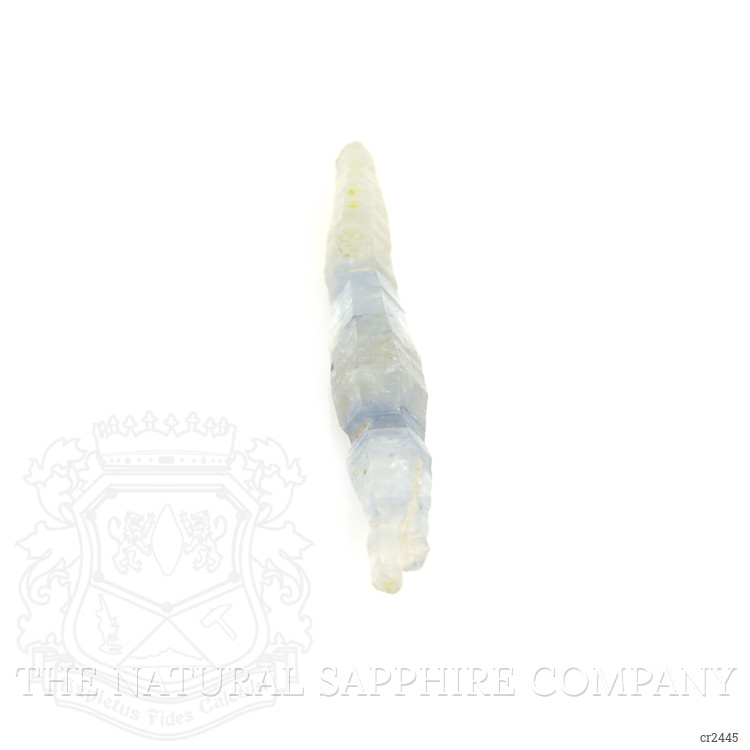

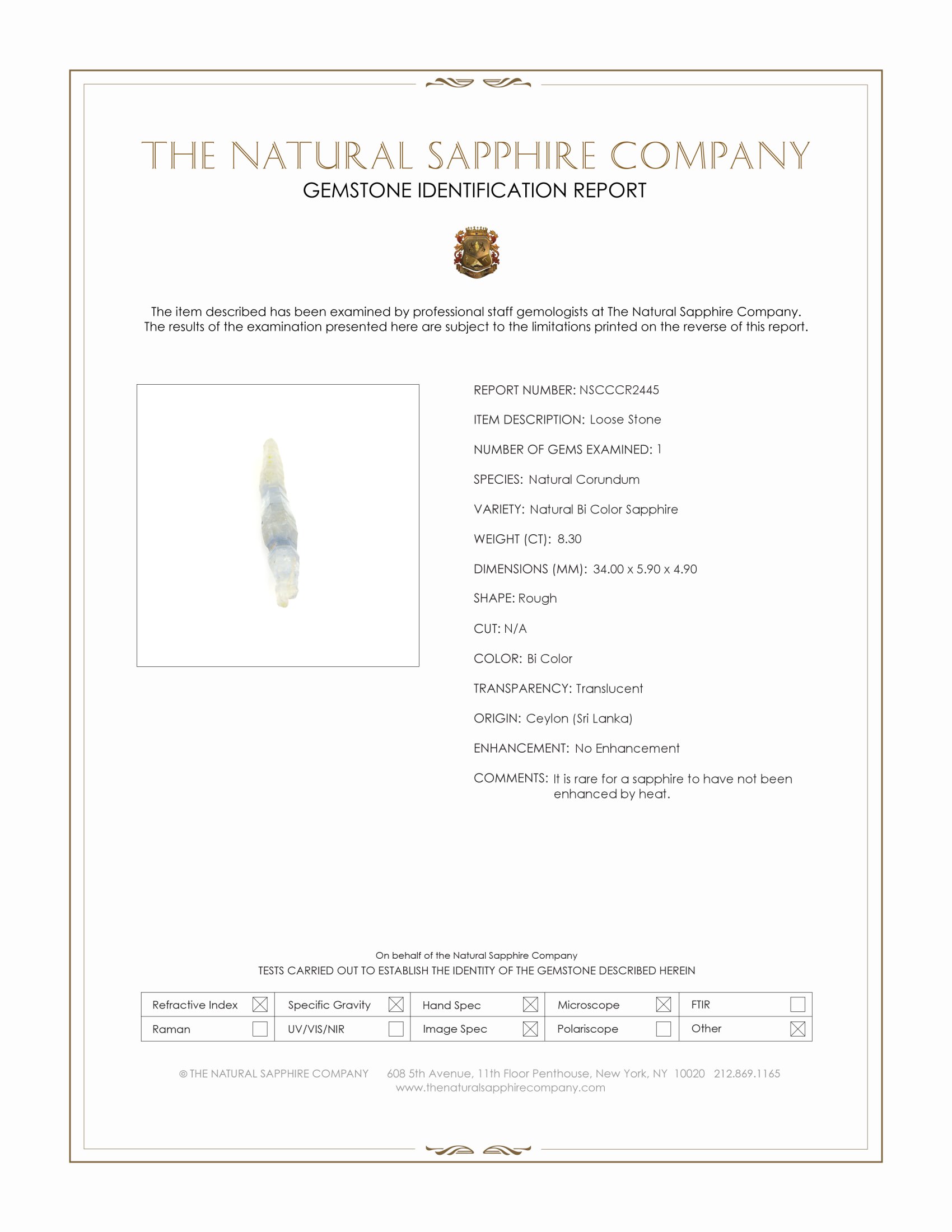
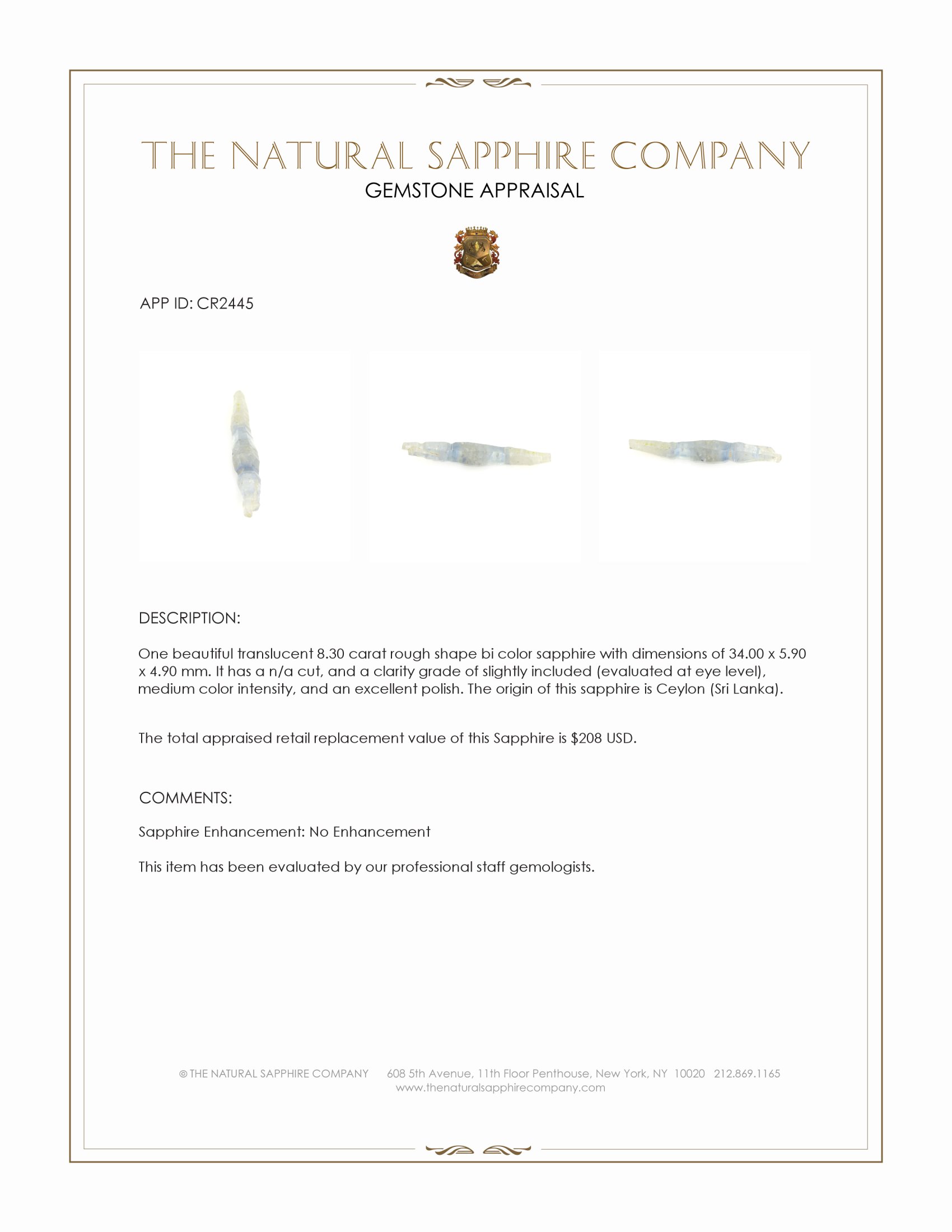
8.30 Ct. Bi Color Rough Sapphire from Ceylon (Sri Lanka)
This loose stone is available to ship now
Item ID: | CR2445 |
|---|---|
Dimensions (MM): help | Length: 34 Width: 5.9 Height: 4.9 |
Weight: | 8.30 Ct. |
Color: help | Bi Color |
Color intensity: help | Medium |
Clarity: help | Slightly Included |
Shape: help | Rough |
Cut: | N/A |
Cutting style: | N/A |
Enhancements: help | No Enhancement |
Origin: help | Ceylon (Sri Lanka) |
Per carat price: help | $25 |
This translucent bi color sapphire presents an immediate technical appeal, originating from Ceylon Sri Lanka, weighing 8.30 carats, with linear dimensions of 34.00 mm by 5.90 mm by 4.90 mm. The natural crystal is described as rough shape, with the listed cut recorded as n a cut, which indicates a specimen that has not been prepared to a conventional faceted profile and therefore offers exceptional latitude for custom cutting strategies. Clarity is graded as slightly included when evaluated at eye level, a characteristic that allows light to travel through the stone with minimal obstruction while preserving natural internal structure that can enhance optical depth. Color intensity is medium, and the piece exhibits a bi color zoning that can be used to create visually dynamic designs. The polish on the existing surface was assessed as excellent, and the stone carries no enhancements, which is a significant factor for collectors and connoisseurs who prioritize untreated corundum. As corundum, the sapphire conforms to the expected physical constants, including a refractive index in the vicinity of 1.762 to 1.770, a birefringence on the order of 0.008 to 0.010, and a Mohs hardness of 9, factors that dictate ideal facet angles, durability in setting, and cutting approach.
From a cutting and faceting perspective, this elongated tabular crystal invites several targeted strategies, depending on the desired end use and the cutter s tolerance for weight retention versus optical yield. The long axis and shallow thickness favor cutting styles that exploit length to produce elongated forms, such as baguette or tapered baguette faceting, emerald step cuts, or a long mixed cut with step facets on the pavilion and brilliant facets on the crown to intensify scintillation while preserving the bi color transition. A cabochon approach can be considered to emphasize the translucent bi color gradient, smoothing internal features into a luminous field suitable for bezel and artisan settings. If the goal is to maximize carat weight, a careful sawing plan can produce one large elongated stone with minimal loss, whereas precision sawing can split the rough into two or three smaller matched pieces for earrings or matched set production. Facet planning should account for corundum s refractive index, targeting pavilion angles in the range of 40 to 43 degrees to optimize return of light and control windowing, and crown angles that balance brilliance with color saturation. The slightly included clarity suggests that strategic orientation of the stone can place any internal features toward the girdle or pavilion where they are less visible, while excellent polish capacity supports creating crisp facet junctions and high luster.
For customization into jewellery settings, the physical proportions and bi color zoning of this sapphire enable a wide spectrum of design solutions, from precision contemporary to organic, hand forged aesthetics. The 34.00 x 5.90 x 4.90 mm profile is well suited for bar and baton settings, east west ring treatments, linear pendant or tie pin applications, and inlay work in bracelets and cufflinks, where the elongated form reads as a clean architectural element. When faceted as a slim baguette or stepped emerald, the stone can be set in channel or flush settings that protect the girdle and highlight the color transition along the length. A bezel setting will enhance the appearance of translucence and provide robust protection, whereas prong mounting with minimal metal exposure will maximize visible surface area and show off the bi color separation. For a more dramatic approach, a long mixed cut with a halo of melee diamonds can be mounted to create a gradient effect from soft Ceylon blue to paler tones, aligning the color zoning so that the focal face presents the deepest hue. Because the stone is untreated, metal choices can be used to influence perceived color, for example warm gold alloys to bring forward golden or yellowish tones, and platinum or white gold to emphasize cooler blue zones.
At The Natural Sapphire Company we approach a specimen like this with a process that integrates gemological planning, CAD based design work, and master cutting that respects the stone s natural characteristics. Our consultation begins with detailed imaging and orientation studies to determine the best axis for cutting or sawing to preserve bi color separation and maximize yield. For clients seeking bespoke jewellery, we provide options including retaining a portion of the original rough for an organic, naturalistic setting, executing precise faceting plans to produce a single statement gem, or dividing the material for matched pairs. Our cutters apply crown and pavilion geometry that corresponds to corundum optical constants, and we can produce CAD visualizations and wax models so the client can assess how color zones will read in a planned setting. Because this sapphire has no enhancements, we recommend providing a gemological report to document origin and treatment status, and we offer mounting services that specify setting stresses, bezel thickness, and prong geometry to ensure long term security without compromising the stone s visual properties. Please contact The Natural Sapphire Company for a technical consultation, cutting proposals, and timelines for producing a finished gem and setting that fully realize the unique potential of this Ceylon bi color sapphire.


