
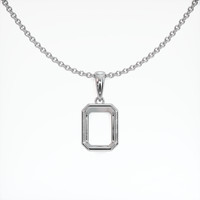
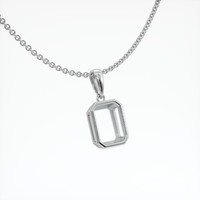
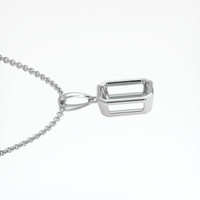


14K White Gold Vedic Pendant Setting


The bezel setting is defined by a continuous, smooth metal border that securely encircles the gemstone, and its design ethos emphasizes protection and refined silhouette. In technical terms the bezel comprises a precisely formed wall and a milled seat, with wall thickness and internal seat profile calibrated to each stone cut and girdle dimension for a flush, secure fit. For step cut stones such as emerald cut or baguette shapes, the bezel wall is typically set slightly below the crown to preserve the pavilion angles and to avoid obstructing the table, and for brilliant cuts the seat is contoured to follow the girdle curve to maintain optimal light return. The burnishing process that folds the bezel lip over the girdle is executed with controlled pressure and incremental passes to avoid introducing stress to the stone surface, and polishing and finishing remove any micro burrs while preserving the intended profile. The bezel offers superior edge protection against chips and lateral impact, reduces snagging on fabrics due to its low profile options, and presents a sleek, continuous metal frame that emphasizes the gem geometry. Finish choices include high polish for maximum contrast with faceting, satin or brushed surfaces for a subdued modern aesthetic, and a soft rounded or chamfered top edge to modulate visual weight. When specifying a custom pendant, bezel height above the table, internal seat radius, and bezel wall thickness are documented and approved to ensure repeatable results and long term stability.
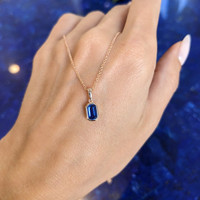
The solitaire style places a single, striking gemstone as the focal point, and the technical considerations focus on the interaction between cut, color grade, clarity, and the chosen setting geometry. Faceting style options include full brilliant and modified brilliant cuts to maximize scintillation, step cuts to emphasize color and clarity with broad flash, and mixed cuts to balance fire and color. For sapphires the color grading spectrum ranges from cornflower blue through royal blue, and selection criteria prioritize hue purity and medium to strong saturation while acknowledging that heat treatment is common and should be disclosed. For rubies the highest commercial color reference is a vivid, slightly purplish red known in trade terms for its intensity, and clarity acceptance is stricter when selecting for solitaire display because inclusions are more visible under single stone focus. For emeralds the most desirable stones show vivid green saturation with even tone, and typical internal characteristics are accepted and stabilized using specific conservation practices that are fully disclosed. The choice of cut affects perceived carat weight and tabletop dimensions, step cuts often present larger table areas while brilliant cuts maximize return in smaller tables. In a solitaire pendant the stone orientation, pavilion angle, and girdle symmetry are specified to minimize light leakage when viewed face up, and the bezel seat is engineered to align with facet junctions to preserve optical performance. Laboratory grading, cut diagrams, and inclusion mapping are recommended for single stone purchases to document expectations and support insurance grade certification.
Customization options are comprehensive, covering metal selection, setting style, stone specification, and craftsmanship techniques, and these options are presented clearly so the client can dictate priorities for color, durability, and finish. Metal choices include rose gold, white gold, yellow gold, and platinum, and each alloy is discussed in terms of color temperature, relative hardness, maintenance, and finishing requirements. White gold is typically rhodium plated to achieve a bright white surface, and periodic replating is a maintenance consideration, while rose gold imparts warm pink tones that may enrich the appearance of red and green stones, and platinum offers superior density and hypoallergenic qualities with a naturally white lustre that lends itself to fine bezel work. Setting styles offered include full bezel, partial bezel, and classic solitaire bails integrated into the top of the bezel, and bespoke options such as low profile or cathedral style bails, hidden suspension, and adjustable chain integration are available. Advanced craftsmanship techniques used in production include CAD modeling for precise tolerances, wax prototyping to evaluate proportions, lost wax casting for structural integrity, hand filing and finishing to refine the seat and bezel lip, micro millwork for exact seat radii, and laser soldering for clean joins with minimal thermal impact. If a client prefers designs inspired by ancient motifs we offer optional patterns and symbolic elements that can be incorporated, however these will only be applied upon explicit request and specification from the client. To proceed please advise preferred metal, stone type and approximate carat or millimeter dimensions, desired cut and color grade emphasis, and whether you require certification or additional finish and engraving options, and we will produce detailed drawings and a production timeline with exact material specifications and craftsmanship notes.

