


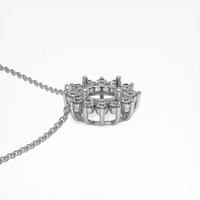


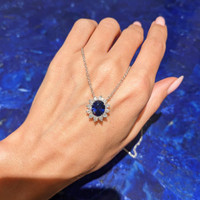
14K White Gold Halo Necklace Setting


This halo style pendant is engineered to maximize the perceived size and optical performance of a center gemstone by surrounding it with a closely matched ring of round melee stones, each calibrated to enhance fire and return of light. The custom made necklace setting is offered in white gold, yellow gold, and platinum, each metal selected and finished to support differing optical objectives and wear characteristics. The halo stones are set in precision drilled seats and retained with four micro prongs per stone, a quadripoint retention system that minimizes metal obstruction of the crown facets while maintaining secure mechanical hold. The gallery is engineered as a low profile basket with graduated thickness through the collet and saddle to control flex, and the pavilion access ports are proportioned to enable repolishing and stone replacement without compromising the integrity of the surrounding beadwork. The chain bail is integrated into the top of the bale with a flush setting to avoid leverage on the pendant axis, and the entire assembly is hand inspected for prong symmetry, seat concentricity, and facet alignment against a 10x loupe standard.
This setting can accommodate a broad range of center gemstone shapes and sizes, with technical tolerances established to preserve ideal facet geometry and girdle plane stability. Round brilliant centers from approximately 0.50 carat to 4.00 carats are supported, with recommended diameter ranges from 5.0 mm up to 9.0 mm, allowing the halo of round melee to sit with consistent bezel to bezel spacing. Oval and marquise shapes are supported with seat templates from 6x4 mm through 12x10 mm, and the collet is scaled to maintain equal crown clearance and even halo spacing, taking into account the extended length of marquise and oval silhouettes. Cushion and radiant cuts, typically used for their hybrid faceting, are accommodated in sizes from 5.0 mm to 10.0 mm across, and the seat geometry is adapted to support either a slightly rounded girdle or a squared corner profile. Step cut emeralds demand a different approach, and this setting is engineered to accept emerald cut centers with dimensions from 5x3 mm up to 10x8 mm, while providing an elevated bezel rim to protect the table corners and reduce the chance of impact damage. Pear and princess shapes are also supported, with the gallery reworked to ensure that point stress is distributed across supporting prongs and that the halo aperture follows the primary outline of the center stone. For each shape the pavilion depth and crown angle recommendations are specified to optimize return of light in the context of the surrounding melee, and the setting tolerances are held to plus or minus 0.10 mm on seat diameter and plus or minus 0.15 mm on seat depth to ensure repeatable fit.
The selection of gemstone types and their expected treatments are addressed with explicit technical guidance to maintain both beauty and durability. For sapphire and ruby, which are varieties of corundum with Mohs hardness of nine, we recommend stones with vivid to strong saturation and medium to medium dark tone to maximize color presence under halo reflection. Heat treatment is common and acceptable when disclosed, and stones should exhibit minimal silk or rutile that could disrupt facet reflections. Emeralds typically possess characteristic inclusions, and their oiling or resin treatments must be stabilized and disclosed, with preference toward stones that are dimensionally stable and set with protective prong geometry or partial bezel for impact resistance. Faceting style should be chosen to complement the halo role, with brilliant and mixed cuts employed to boost scintillation for stones in the center, and step cuts used sparingly when a calm, architectural aesthetic is desired. Metal choice influences perceived color and optical warmth, and platinum provides maximum ductility and long term prong retention, while 18 karat yellow gold enhances warmth of ruby and certain sapphires, and rhodium plated white gold matches the visual appearance of platinum while reducing cost. All pieces are finished with hand burnishing of prongs, final ultrasonic cleaning, and a quality control sweep that includes a torque test on prongs, a visual examination for light leakage at facet junctions, and an appraisal grade photographic record. For customers seeking exacting specifications we provide CAD drawings with annotated dimensions, and we will calibrate seat profiles to the specific lapidary notes of the center stone prior to final fabrication.

