
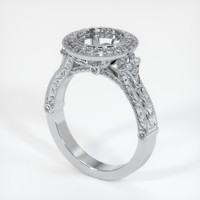
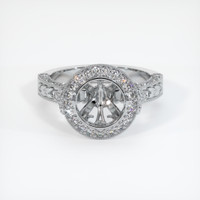
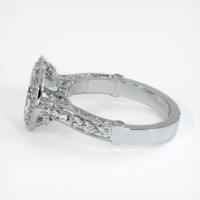
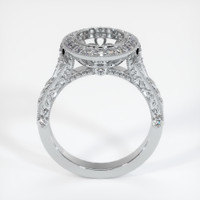


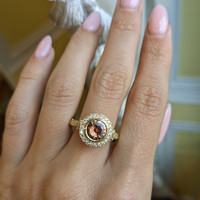
Silver Antique Style Ring Setting


This custom made ring setting is engineered to accommodate a wide range of center gemstones and metal choices, offering precision options in rose gold, white gold, yellow gold, and platinum, and designed to accept sapphires, rubies, emeralds, and other gemstones with equal technical care. The design vocabulary combines pave, halo, antique, and bezel approaches, to deliver both aesthetic versatility and mechanical integrity. Each metal option is specified by karat and alloy profile to balance color and hardness, with 18k gold providing a richer hue and higher gold content, and 14k gold offering increased wear resistance for clients who prioritize daily durability. White gold receives rhodium finishing to achieve a bright white appearance and to enhance surface hardness, while platinum is recommended for its high density and superior fatigue resistance around settings that require long term stability. For colored stones, attention is paid to material class, corundum for sapphires and rubies, and beryl for emeralds, with recommendations on acceptable clarity and treatment histories, to ensure that the chosen center stone harmonizes with the setting geometry and the intended light performance.
The bezel setting is described here in technical detail, focusing on the smooth metal border that securely encircles the gemstone, providing a protective lip that reduces exposure of the girdle and pavilion to impact. The bezel is formed from a continuous metal wall that is drawn and shaped to match the exact silhouette of the stone, then finished with a bezel seat that conforms to the stone girdle for even load distribution. Full bezels provide maximal protection by covering the entire circumference, while partial bezels or bezel half settings can be used to reveal more of the crown and table, optimizing return of light for stones with high refractive indices. Bezel thickness and wall profile are calibrated against the center stone diameter and crown height to avoid over masking of the table, and to preserve the intended optical return. Milling of the bezel lip is performed with micro tools to ensure a consistent radius, and the final surface is polished to a mirror finish or given a brushed texture according to the client specification. For faceting styles, step cut stones such as emerald cuts or asschers are often well suited to a low profile bezel that protects sharp corners, while brilliant cuts benefit from carefully calibrated partial bezel positions that maintain scintillation. The bezel also allows for precision engraving on the exterior face and for integrated anti twist shoulders inside the gallery, enhancing both security and wearer comfort.
The halo style is executed as a concentric assembly where a center gemstone is surrounded by a ring of smaller stones, creating a multiplied visual aperture and increased apparent diameter of the focal gem. Halo stones are typically melee size, selected for matched cut class, consistent table and crown angles, and tight tolerances in diameter grading, so that the ring reads as a continuous circle without perceptible gaps. The halo system increases perceived brightness by introducing multiple reflective elements around the table of the center stone, and by framing the central crown in a controlled contrast field. Technical considerations include the selection of stone shapes for the halo, the use of round brilliant melee for maximal scintillation, and the possibility of tapered or baguette halo components to follow an oval or marquise center. The halo carriage is engineered with a minimal bezel or bead setting for each melee, securing each stone with uniform bead size and consistent seat depth, while maintaining structural channels that prevent stone migration. When paired with colored gemstones, the halo can be tuned to a specific color temperature, for example a warm rose gold halo can complement a pinkish sapphire, while a white gold halo presents an optically neutral field that increases white light return for deep blue sapphires or vivid rubies. Proportional calculations are applied to the halo inner diameter and outer diameter to achieve a target overall spread, allowing clients to predict the visual carat equivalent based on center stone size and total melee carat weight.
The pave style is executed as a closely set field of small diamonds or gemstones, set with minimal metal visibility to create a continuous sparkle and an elegant, seamless appearance. Pave is defined by consistent melee selection, typically full cut brilliants with matched pavilion depths and a narrow spread in color grades and clarity grades to avoid visible variation under loupe inspection. The bead setting technique is employed to secure each stone, with bead placement and bead mass controlled to resist retipping, and with undercutting engineered to eliminate stress risers in the surrounding metal. The ring shank and shoulders are designed to accept a pave mattress that balances stone density with structural cross section, ensuring that the shank retains sufficient thickness to resist deformation while still presenting a high ratio of visible stones. For antique style interpretations, pave rows may be punctuated by hand cut milgrain edges and openwork filigree under gallery construction to reduce weight and to allow light ingress to the melee pavements. Craftsmanship steps include CAD driven nesting for optimal stone layout, lost wax casting of the primary form, and sequential hand setting by experienced setters, each stone verified for seating depth and bead uniformity. Final surface finishing may include selective rhodium plating for white gold settings, and a protective lacquer is avoided to keep the piece repairable and serviceable. For clients seeking precise technical specifications, we provide a detailed build sheet that lists bezel wall thickness, halo inner and outer diameters, individual melee sizes and counts, total carat weight range, recommended center stone proportions by cut style, and a post manufacture inspection certificate that documents set tolerances and finish quality, ensuring the finished ring meets expectations for both aesthetic return and long term mechanical reliability.

