


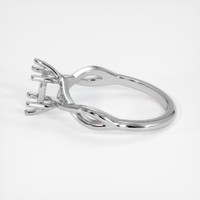


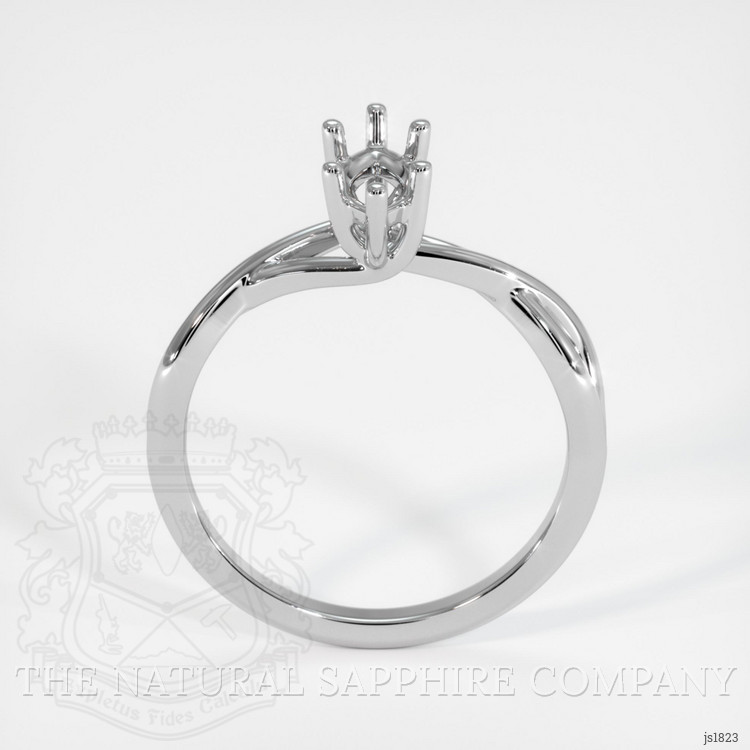

Platinum 950 Solitaire Ring Setting


The solitaire ring presented here is a study in focused restraint, configured to showcase a single, high quality center stone with minimal visual interference from the mounting. Offered as a custom made setting in rose gold, white gold, yellow gold, platinum, or silver, the design accepts sapphires, rubies, emeralds, and other faceted gemstones, and it emphasizes classical proportions and modern mechanical precision. The profile features a discrete crown and an elevated head that clears the finger to allow optimal light ingress to the pavilion, while a low mass gallery preserves a clean silhouette. The shank exhibits a gently tapered, interlaced profile that reduces metal shadowing around the crown, and the head is engineered to accept common faceting geometries, from round brilliant to oval, cushion, and emerald cuts. For corundum family stones such as sapphires and rubies, the setting accommodates both mixed cuts that balance brilliance and color, and modified brilliants that maximize return, while for emeralds the seat is shaped to support longer step facets and to protect against cleavage planes.
The technical specification of the setting is tuned to complementary gem characteristics. For round brilliant cuts the ring supports ideal proportions, with a table near fifty four to fifty eight percent, a crown angle in the mid thirties degrees, and a pavilion angle close to forty one degrees, parameters that together optimize internal reflection and dispersion for high scintillation. For step cut gems the bezel tolerance and prong placement are adjusted to the rectangular table and longer facets so that color saturation and clarity are showcased without excess glare. Corundum stones have a refractive index around one point seven six to one point seven seven and a low dispersion that renders color saturation more significant than fire, so the crown and pavilion geometry are selected to deepen hue while preserving light return. Emeralds have a lower refractive index and typically exhibit inclusions, therefore the setting allows for a slightly lower crown and a more open pavilion to enhance perceived clarity and depth of color. Color grading guidance is incorporated into the selection process, with recommendations for hue, tone, and saturation that take into account the selected metal, because rose gold and yellow gold warm the appearance of red and blue stones, while white metals preserve true tone and contrast.
Security and optical performance are achieved through convergent engineering of prong architecture, seat geometry, and material choice. The head utilizes a multi prong cage that combines tapered, heat formed prongs with a contoured seat, creating a mechanical bite into the stone girdle that resists lateral forces while minimizing metal intrusion into the crown table area. Prongs are drawn and burnished to flow into the girdle with a radiused contact surface, reducing point stress and lowering the risk of chipping, and the prong thickness is selected according to stone size and hardness, with platinum or high karat gold recommended for larger stones because of superior tensile strength. The basket and gallery are open by design, aligned to admit oblique light to the pavilion and to allow inspection and cleaning without disassembling the mount, and key contact points are machined to tight tolerance, typically within zero point zero five to zero point one millimeter, to ensure consistent seat fit and repeatable stress distribution. The internal angles of the head are optimized to avoid light leakage through excessive metal, while the polished underbezel reflects light back into the pavilion planes, increasing apparent brilliance. Craftsmanship techniques include hand setting with meticulous burnishing, ultrasonic cleaning followed by final hand polishing, and a quality control step that simulates lateral and tensile loading to validate prong retention. Each custom setting can be specified with factory recommended proportions for the chosen gemstone type, and we advise certification for clarity and color for buyers who require precise grading documentation.

