
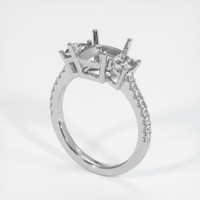


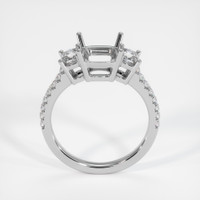


18K White Gold Three Stone Ring Setting


This custom made ring setting is engineered to serve as both a precise gem mount and a meaningful emblem, conveying a promise, a milestone, or a chapter in a love story. The design centers on a structured head intended to accept a primary gemstone such as sapphire, ruby, emerald, or an alternative precious stone, while retaining the visual balance necessary for a ceremonious gift. The silhouette is purposeful, with a raised gallery that allows light to enter the pavilion of the center stone from multiple angles, and shoulders that taper to complement the hand without overpowering the focal gem. Presenting a ring setting as a gift in this form emphasizes intention and adaptability, because the receiver may select their preferred center stone and final finishing metal, transforming a technical skeleton into a personal emblem. For buyers who appreciate the craft, this setting signals that the giver has invested in an object that is neither off the shelf nor casual, but rather a considered framework for a lifetime of wear, a technical platform for optimal gem performance, and a vessel for a narrative of commitment or accomplishment.
Material selection and fabrication details define the long term behavior and aesthetic interaction between metal and gemstone, and this setting is offered in an extensive range of alloys to match those requirements. Available metals include 10 karat yellow gold, 14 karat yellow gold, 14 karat rose gold, 14 karat white gold, 18 karat white gold, 18 karat yellow gold, platinum 950, and sterling silver, as well as mixed white and yellow combinations in 14 karat and 18 karat variants. Each alloy delivers a distinct hardness, ductility, and color temperature, and these factors determine prong resilience and the degree of need for future maintenance. White gold options are supplied with the option of rhodium plating to enhance perceived whiteness and scratch resistance, while rose gold increases perceived warmth and complements red and pink hues in gemstones. Platinum 950 is recommended for its tensile strength and low reactivity, especially when mounting high value center stones, because platinum retains prong mass and resists thinning over decades. Fabrication employs computer aided modeling followed by lost wax casting for the initial form, then hand fitting of prongs, precision milling of the seating bezel, and flame or laser welding where structural reinforcement is required. All settings are hand finished to ensure even polish and consistent prong geometry.
The gemology considerations built into the setting respond to the optical characteristics of different center stones and the designated cushion shaped side stones. Sapphires and rubies, as corundum species, perform best with cuts that maximize light return while managing strong saturation, and a pavilion outline that preserves face up color is preferred. Emeralds demand attention to clarity patterns and often benefit from slightly larger tables and tailored pavilion depths to compensate for internal inclusions while preserving color. For each potential center stone the setting allows adjustment of bezel seat depth, prong span, and crown clearance so that faceting angles can interact with the gallery geometry to produce optimal scintillation. The side stones are specified as cushion shape, and the cushion profile can be executed in either a modified brilliant cushion or a classic pillow cut with blocky facets depending on whether brilliance or color dispersion is the priority. Cushion cuts employ a combination of large crown facets and graded pavilion facets, and when matched properly to the center stone they create a coherent light field across the ring. The design also integrates a row of micro pavé accent stones along the shoulders, each set in crescent shaped seats with micro prongs for secure retention and minimal metal visibility, thereby increasing apparent carat weight and contributing to a continuous reflective surface that visually extends the center group.
Customization and final assembly prioritize secure gem retention, longevity, and the tactile experience that underpins the symbolism of gifting a setting. Prong geometry is executed with a focus on load distribution, with each prong leg shaped and burnished to cradle pavilion girdles without stress concentrations. The gallery structure is reinforced with a double bar bridging the head where needed, and stress relief at the shoulder is introduced through controlled filleting and internal radius profiling to prevent hairline cracking during sizing. Sizing adjustments are made by removing or adding metal at the base of the shank with subsequent anneal and hand polishing, preserving the factory finish and the precise relationship between head height and finger curvature. For clients who prioritize a warm presentation, rose gold and yellow gold finishes are advised alongside cushion side stones that emphasize fire, whereas for those seeking a neutral backdrop that favors colorless contrast, platinum or rhodium plated white gold is recommended. When the setting is presented as a gift it carries layered meanings, because the technical choices embodied in the piece reflect an understanding of gem behavior, a commitment to durability, and an invitation for the recipient to complete the ring with their own center stone selection. Our atelier offers consultative guidance on stone proportions, color grading thresholds, and matching facets, and we welcome the opportunity to tailor each parameter so that the finished ring setting is both a precision made object and a lasting symbol of promise, achievement, or love.

