


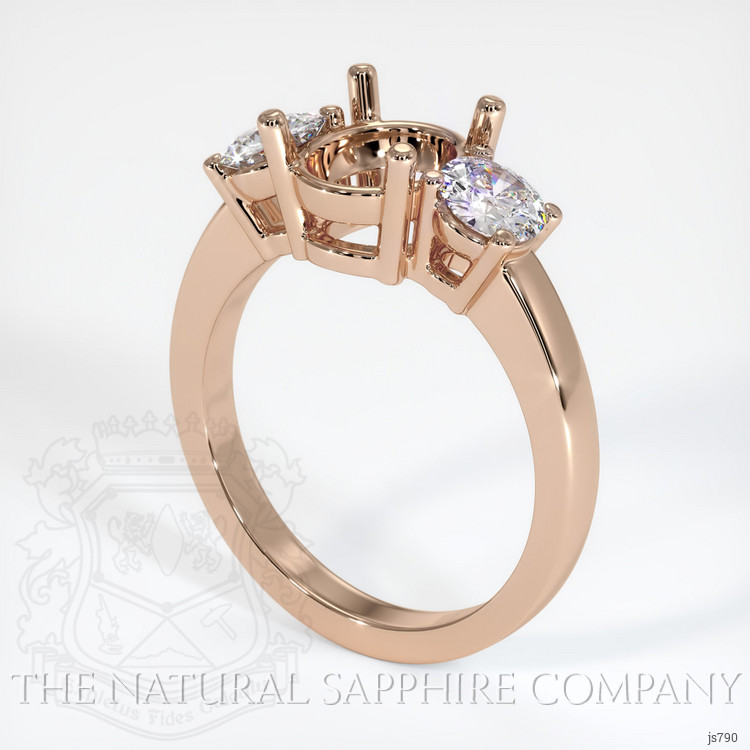
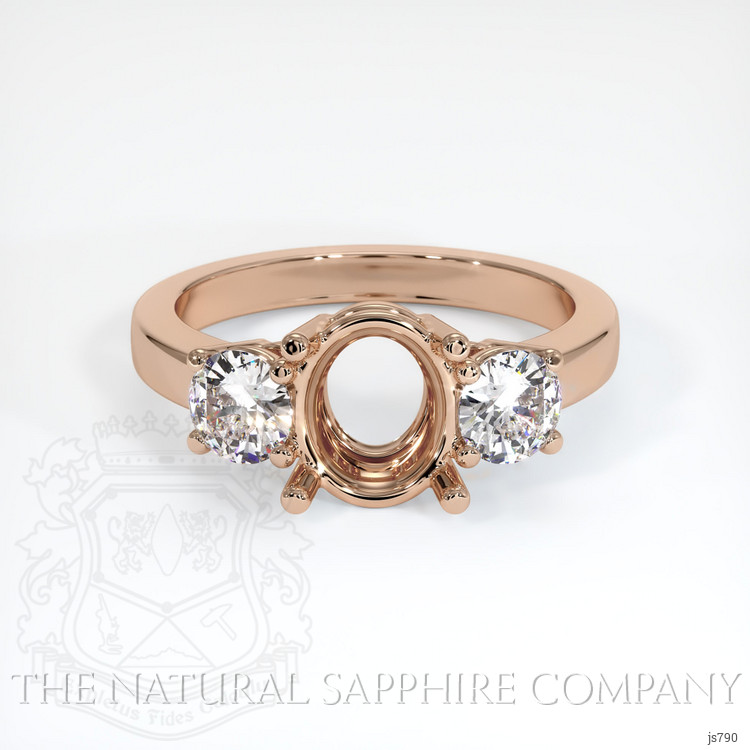
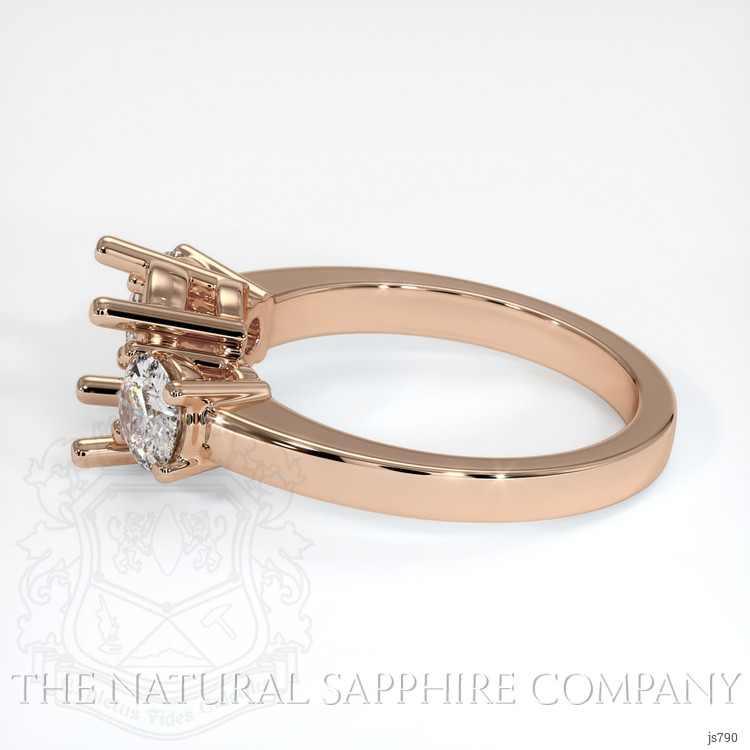
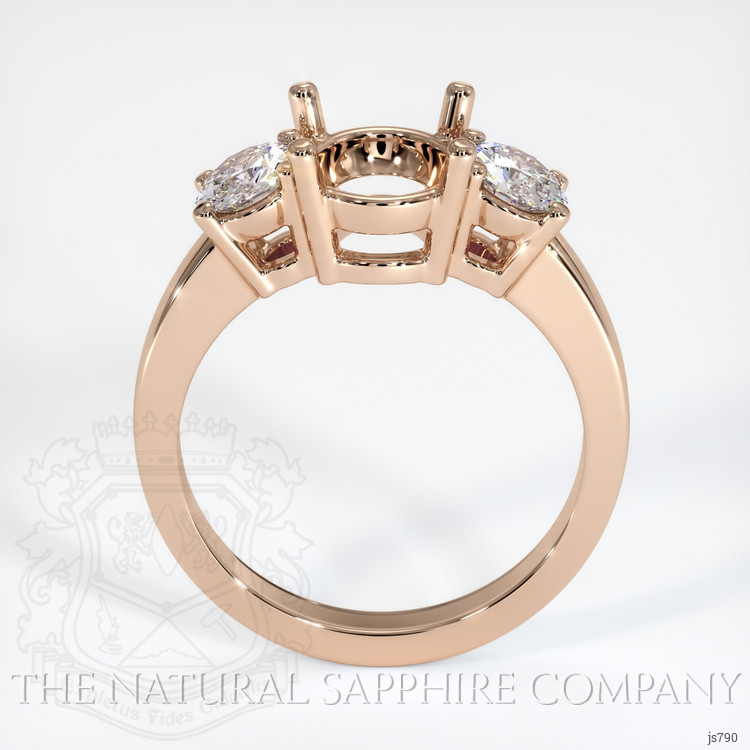

18K Rose Gold Three Stone Ring Setting


The three stone style in this custom made ring setting articulates a narrative through proportional geometry, linking past, present, and future within a compact and balanced structural framework. This design employs a central four prong head flanked by supporting shoulders engineered to carry round accent stones, producing a classical silhouette that is both elegant and technically resilient. The setting metal choices include rose gold, white gold, yellow gold, platinum, single tone golds, and two tone combinations such as white and yellow. Each metal influences both the visual temperature and the functional properties of the mount, with platinum offering superior density and wear resistance, and higher gold karats providing a warmer hue and slightly softer metal behavior during setting and maintenance. The pictured configuration emphasizes a raised basket with an open gallery to optimize light return to the center stone, while the shoulder thickness and prong geometry allow secure retention of both the main gem and up to four round accent stones without compromising the intended three stone aesthetic.
This ring setting accommodates a broad spectrum of center stone shapes and sizes, with engineering allowances made for round brilliant, oval, cushion brilliant, emerald cut, asscher, princess, pear, and marquise centers. For round brilliant centers the standard basket geometry performs optimally with table to depth proportions in the classic brilliant range, translating to ideal pavilion angles for maximum sparkle. Step cut stones such as emerald and asscher require a modified seat and taller bezel or four corner prong reinforcement to support shallower pavilion depths and larger tables, while fancy shapes like pear and marquise need asymmetric prong placement and a reinforced bridge on the pointed end. Typical center sizes accommodated without structural modification range from 0.50 carat to 3.00 carats for stock head dimensions, and bespoke alterations can extend this range both smaller and larger. The side accents are designed as round brilliant melee, commonly sized from 1.50 millimeters to 3.50 millimeters, positioned as four round accents integrated into the shoulders or gallery to complement the center stone visually and optically.
Attention to faceting styles, color grades, and finishing details defines the refinement of the final piece. For center stones such as sapphire, ruby, and emerald, evaluation emphasizes hue, tone, and saturation rather than diamond color grading, with optimal trade offs between vivid saturation and clarity in mind. Sapphires and rubies, both corundum, respond well to brilliant or mixed cutting to maximize color and light return, and they offer a Mohs hardness of 9 which allows for more aggressive setting profiles. Emeralds generally present more inclusions and a Mohs hardness near 7.5 to 8, requiring protective setting strategies such as lower prong height or partial bezel to mitigate impact and prevent fracture. Faceting nuances include pavilion angle optimization for brilliant cuts, careful girdle profiling for step cuts to avoid edge chipping, and crown slope adjustments to control scintillation and color dispersion. Accents executed as round brilliant melee should present tight facet symmetry and consistent table percentages to assure even sparkle when clustered around the center stone.
Craftsmanship techniques applied to this three stone setting combine traditional hand finishing with modern fabrication technologies to ensure repeatable precision and long term durability. The head and gallery are typically formed by CAD driven modeling followed by selective casting, then refined by hand to set bezel seats, mill prong tangs, and verify stone seats. Prongs may be tapered and burnished to hold the stone securely, and re tip profiles are planned to facilitate future maintenance. For white gold options rhodium plating is applied for color consistency and surface hardness, while rose gold alloys are patinated by controlled copper content to achieve the desired hue. Solder joints are executed with inert gas soldering or laser welding where visibility is critical, minimizing heat migration into adjacent stone settings. Channel or bead setting of the round accents is done with calibrated burs and setting punches to maintain even spacing and prevent over stress on each melee. During client consultations we confirm exact center stone dimensions, preferred faceting style, and acceptable color and clarity ranges, and we provide guidance for maintenance including periodic prong inspections, careful cleaning protocols for fragile emeralds, and recommended timelines for professional polishing and re plating.

