


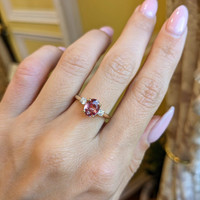
14K White Gold Three Stone Ring Setting


The three stone style is a classical approach to ring design that places a single central gemstone between two companion stones, creating a clear narrative of past, present, and future through gem placement. In this interpretation the center stone remains the visual and symbolic focus, while the flanking rounds establish proportion and balance, creating a composition that reads as cohesive from every angle. Proportions are carefully considered so that the center stone reads as dominant without the side stones appearing merely decorative, the side stones serve to emphasize the center through matched color saturation, consistent cut quality, and calibrated diameter. Visually the result is an elegant profile that is at once meaningful and restrained, the geometry of the mount supports light return to the center stone while the paired rounds provide lateral brilliance that frames the principal gem. The three stone arrangement adapts well to colored center gemstones such as sapphire, ruby, and emerald, as well as to other gemstones chosen for personal significance, the choice of side stones and metal finish further refines the character of the piece, whether the intent is understated contrast or seamless tonal unity.
Custom Made Ring Setting, Setting Metal Type By 14K Rose Gold, 18K Rose Gold, 14K White Gold, 18K White Gold, 14K Yellow Gold, 18K Yellow Gold, Platinum 950, Silver, 14K White and Yellow, 18K White and Yellow, 14K Yellow and White, 18K Yellow and White, Center Stone type by Sapphire, Ruby, Emerald, Gemstone, Design Style by Three Stone, Side Stone Type by 4, Side Stone Shape by Round. The setting is offered as a made to order component to accommodate selected center gemstones and precise sizing requirements, metal selection influences both lustre and structural properties, platinum 950 provides high density and long term resilience, 18 karat options increase the gold content and warm the hue, mixed metal two tone options are available for design contrast. The specification permits a variety of center gems and requires selection of round side stones, the listed side stone count and shape guide the setting geometry so that the mounting and prong positions are engineered for consistent seat and alignment across the ring.
The physical configuration of the head and shoulders is optimized to provide maximum security for the center stone while maintaining a delicate visual presence. The center is seated within a purpose formed multi prong head where each prong is tapered and contoured to cup the girdle without excessive mass, the prongs rise from reinforced shoulders and an integral gallery bar to distribute impact loads away from the stone. The side rounds are set in precise crowns that locate the stones and resist rotation, the seats are cut to the exact girdle diameter for a tight fit, and the prong tips are burnished over the stone to reduce the chance of snagging while preserving minimal visible metal. Structural reinforcement is placed where the shank meets the head, the undergallery and bridge provide hidden support so the upper silhouette can remain slim and refined. Choice of metal affects wall thickness and tensile strength, the heavier alloys permit finer looking prongs with increased resistance to bending, the softer alloys can be specified with slightly thicker prongs to achieve equivalent security without compromising the slender aesthetic. For gemstones with lower toughness such as emeralds the setting geometry can be adjusted to increase bezel contact at vulnerable facets, maintaining safety while retaining the three stone arrangement.
Practical considerations for wear and maintenance are addressed through the construction and through recommended care procedures, the engineered prong geometry reduces everyday catching and concentrates potential wear at accessible locations so routine inspection and re tipping restore full security. The configuration is suitable for frequent wear when selected with appropriate metal and stone combinations, colored gemstones are selected with attention to hardness and fracture toughness, sapphires and rubies offer high durability for regular use, emeralds require more cautious handling and benefit from careful prong placement and periodic checks. Customization options include altering side stone size and count within the framework of the three stone aesthetic, adjusting prong profile and gallery height to harmonize with the chosen center cut, and selecting mixed metal combinations to emphasize the stone color or to coordinate with existing jewelry. The result is a considered, functional setting that communicates meaning through its three stone composition, secures each gemstone with engineered restraint, and preserves a delicate, wearable profile through subtle structural detailing.

