
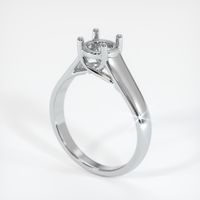


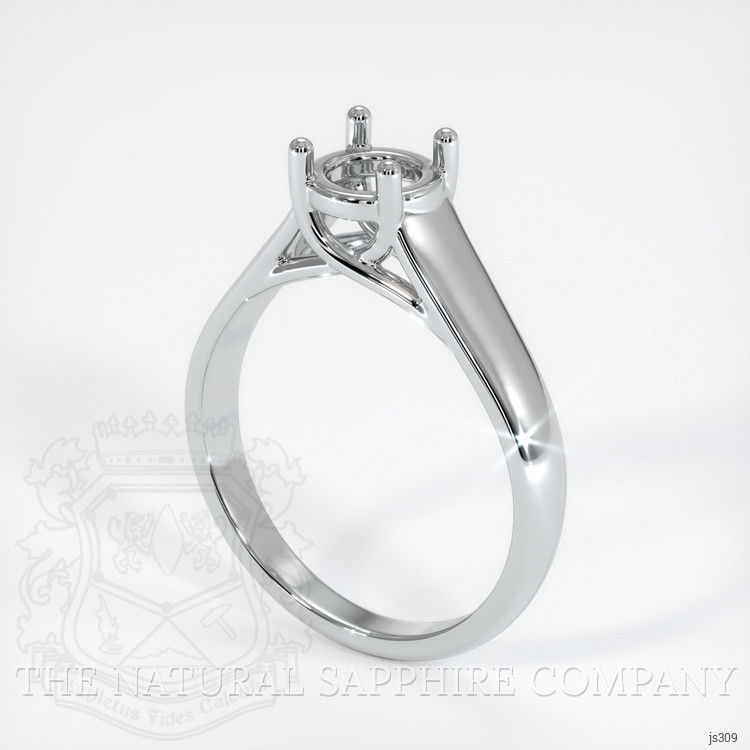
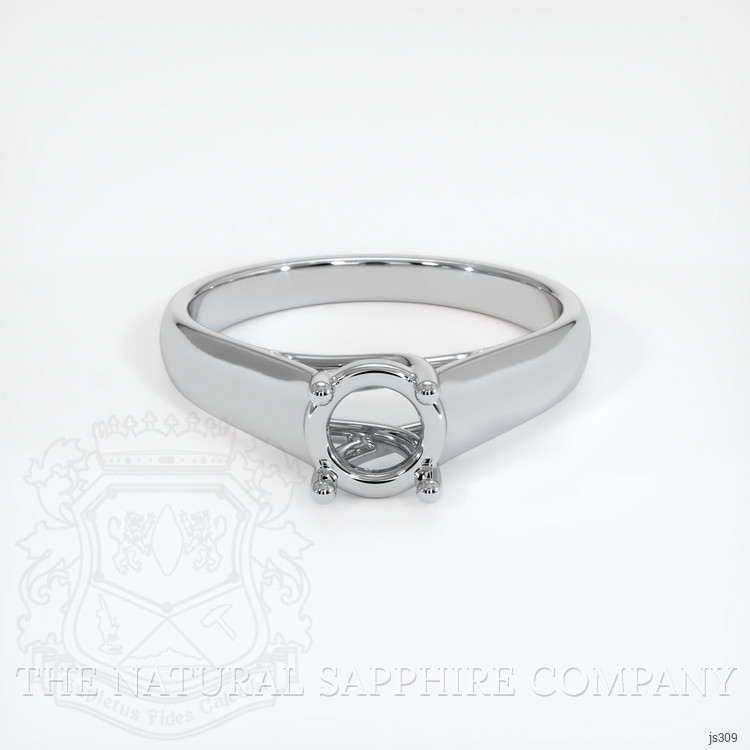
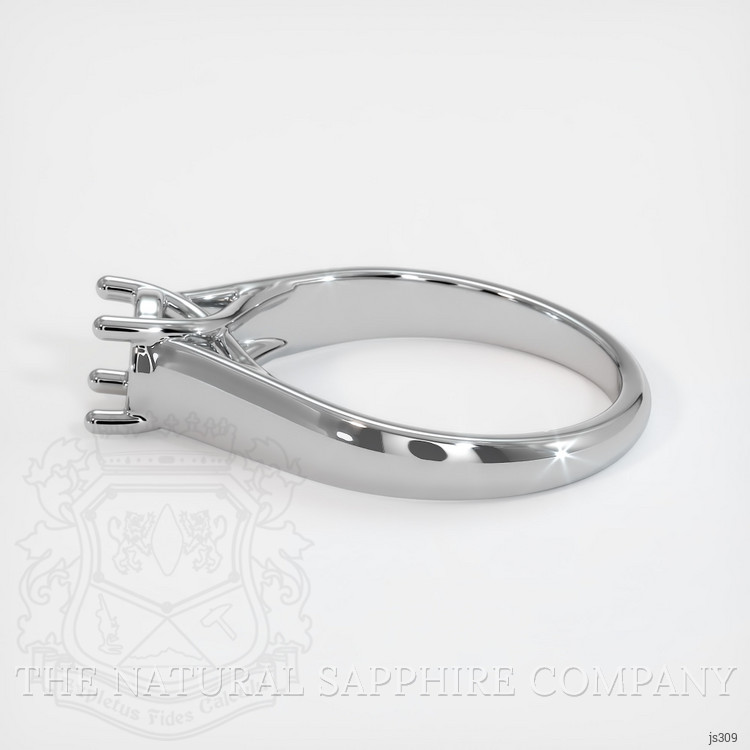
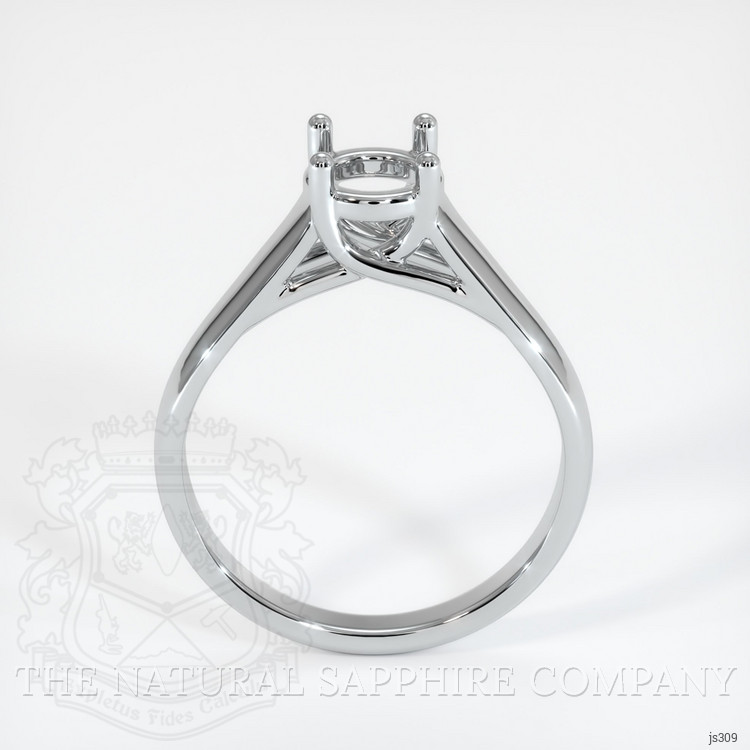
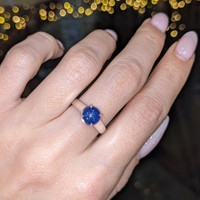
14K White Gold Solitaire Ring Setting


This solitaire setting has been engineered to present a single, decisive gemstone as the optical and structural center of the piece, offering a restrained, timeless silhouette that reads as classic and refined. The head is configured as a four prong crown with a tapered profile, each prong milled from a continuous bar of metal and drawn up to meet the girdle with a rounded tip to minimize point pressure on the stone. The basket beneath the crown is open and engineered with triangular undergallery struts that transfer load into the shank, creating a cathedral like rise that accentuates the gemstone while maintaining a low profile to reduce snagging. The seat accepts standard round brilliant and mixed cuts directly, and it can be adapted to oval, cushion, and emerald cuts by altering prong geometry and seat radius, preserving proportional table clearance and pavilion angle relationships for optimal light return. Every line is calculated to reveal the table facet unimpeded, while the polished surfaces and chamfered edges on the shoulders keep reflections crisp and controlled, enhancing perceived size without added mass.
Security is achieved through a combination of mechanical geometry and metallurgical finishing, resulting in a setting that secures the stone more reliably than a simple claw alone, while keeping the visual language delicate. The prongs are tapered in cross section, broad at the base to resist bending and narrow at the crown to read fine, each prong head being burnished and planished over the girdle to a contact band that distributes clamping force evenly around the stone. The undergallery struts function as load bearing ribs that prevent lateral torque and moment induced loosening, and the inner profile of the seat is radiused to cradle the girdle without creating stress risers. For step cut stones and emeralds that show cleavage planes and internal fissures, we specify a slightly wider seat and softer burnish to avoid point loading, and for corundum family stones such as sapphire and ruby we recommend tighter tension and higher prong taper since these materials have higher toughness and resist chipping under controlled contact. All prongs are annealed at a controlled temperature cycle post forming to relieve work hardening, then tempered through controlled cold work to yield a balance of ductility and spring back for retention.
Customization and workshop control conclude the technical story, offering buyers the ability to choose setting metal and to match stone characteristics with appropriate head geometry and finish. Metals are offered in rose gold, white gold, yellow gold, and platinum, with 18 karat or 14 karat options available on gold alloys to adjust hardness and color saturation. White gold pieces are rhodium plated for optical neutrality and scratch resistance, and platinum is supplied in 950 purity with heavier cross sections at the prong base where needed for fatigue resistance. The fabrication sequence begins with CAD modeling to exacting tolerances, followed by lost wax casting, hand filing of the prong profiles, iterative test seating with calibrated mock stones, and final burnishing and polishing. Each ring is inspected under 10 power magnification for seat symmetry, crown straightness, and prong wall thickness, and a retention test is performed to simulate lateral and axial forces. In combination these design and production choices deliver a solitaire that reads delicate on the finger, secures the chosen sapphire, ruby, emerald, or other gemstone with professional grade mechanics, and allows for precise tailoring to the stone quality, including faceting style, table size, and color saturation.

