


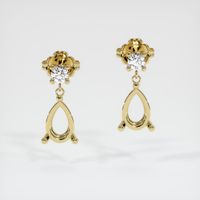


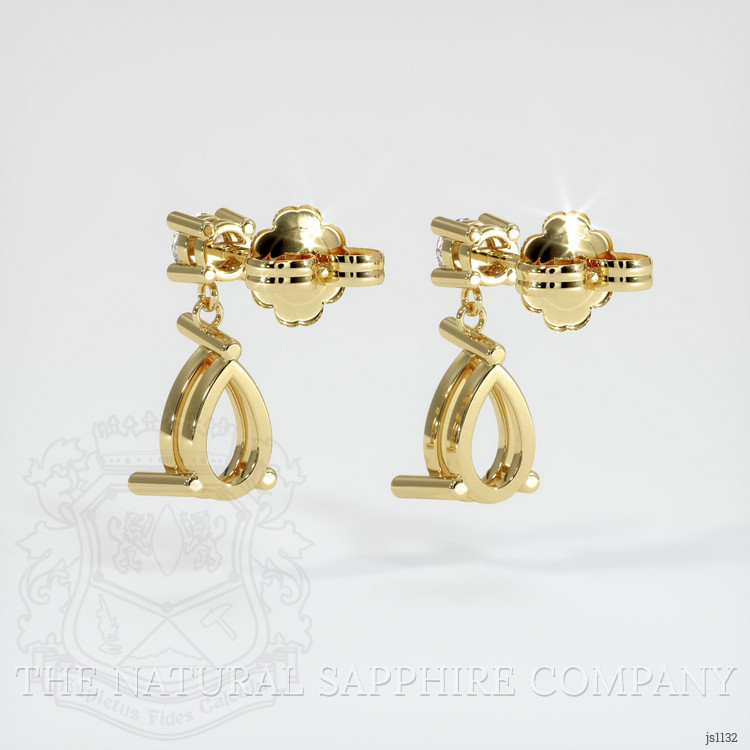
18K Yellow Gold Accent Stones Earring Setting


Accent stones in this design are executed as a precision halo and shoulder treatment, where smaller round gemstones are calibrated and set concentrically around a primary center stone to augment optical performance and perceived carat weight. The accent stones are round brilliant style cuts, specified to maximize facet interaction with the crown and pavilion angles of the center gem, so that scintillation and flash are coherent across the composition. Setting options include micro bead settings for a low profile contiguous surface, shared prong settings to minimize metal visibility and enhance light admission, or channel pavé for linear balance along the shoulder, each approach altering the way light refracts through the crown facets. When using colored center stones such as sapphire, ruby or emerald, contrast and color halo effects are carefully considered, with warm metallics like rose gold intensifying saturated reds and pinks, and white metals preserving the true hue of blues and greens. Technical considerations include matching approximate refractive indices to avoid color bleed, selecting side stone sizes typically in the 1.5 to 2.5 millimeter range for proportional balance, and using a consistent facet finish to prevent optical misalignment that can diminish overall brilliance.
The drop element of these earrings is engineered to provide articulate movement while maintaining a stable center of gravity to prevent excessive torque on the earlobe. The drop is constructed as a hinged bail with a single articulation point, allowing the pear shaped or teardrop contour to hang below the stud assembly and respond to motion with controlled resonance. Structural dimensions are calculated to limit pendulum amplitude, using thicker walls at the attachment link and fine internal milling to reduce weight without sacrificing rigidity. For heavier center stones or larger metal volumes, a two stage articulation can be specified to distribute dynamic loads across the post and back, reducing micro fatigue on the ear piercing. Surface finishing on the drop is critical, since high polish reflects and redirects light from the center and accent stones, while satin or brushed finishes can provide contrast and delineation of form. In customizable settings, the pavilion clearance and prong articulation are adjusted to accommodate cushion, oval or mixed cuts, ensuring the drop sits flush when at rest and clears the neckline when in motion.
This product is a custom made earring setting available in rose gold, white gold, yellow gold, platinum, or a two tone yellow and white combination, and it is designed to accept a choice of center stone options including sapphire, ruby, emerald or other calibrated gemstones, with four round side stones positioned as accent elements. The geometry of the setting follows precision CAD modeling, translated to lost wax casting or direct metal fabrication, with hand finishing stages for seat geometry and prong profiling. Prongs are tapered and burnished to lock girdle and crown interface points, with seat depths milled to industry tolerances so that a 4 prong or 6 prong center mounting can be executed without gape or overbite, preserving girdle integrity and minimizing stress risers. Metal selection affects alloy hardness and hue, for example rose gold contains copper for color saturation and increased hardness, platinum offers higher density and superior long term fatigue resistance, and rhodium plating over white gold achieves a bright white appearance while requiring occasional maintenance. The four round side stones are set to ensure consistent elevation and azimuthal alignment, improving ensemble symmetry and enabling predictable light return when paired with various center stone faceting styles such as round brilliant, mixed cut, or modified cushion.
Closure type directly impacts both security and wearer comfort, and the selection should be correlated to overall earring mass and intended activity profile. Push backs, commonly referred to as friction backs, offer quick insertion and a level of comfort due to minimal bulk behind the ear, however their retention relies on friction against the post and they are best suited to lighter studs and low profile drops. Screw backs provide superior mechanical security because the back threads onto the post, preventing accidental disengagement, and are preferred for valuable center stones or for wear in situations with higher risk of snagging, though they require additional handling time and may be less convenient for frequent removal. Lever backs are a hinged enclosure that trap the post within a loop, combining ease of use with a positive closure action, they distribute weight across the ear and reduce axial pull on the piercing, making them advantageous for heavier drops that still require frequent on and off. Post diameter and taper, typically within the 0.7 to 0.9 millimeter range for standard gauges, are specified to match the closure type and to balance insertion comfort with retention force, and material finish and plating are chosen to minimize skin irritation and to maintain smooth action over repeated use.

