
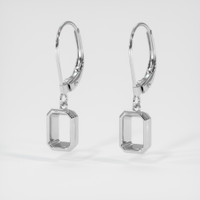
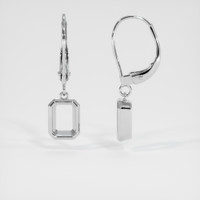


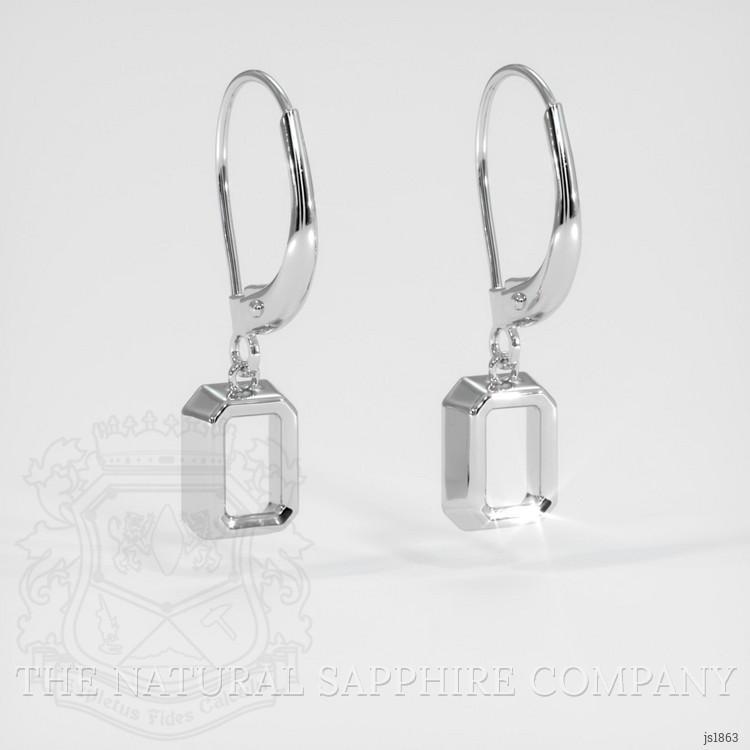
14K White Gold Bezel Earring Setting


The bezel setting employed in this custom earring is engineered as a continuous smooth metal rim that fully encircles the stone, creating a uniform protective band that registers precisely with the stone girdle, the table plane, and the pavilion apex. The bezel wall is machined and hand finished to a nominal thickness that varies according to stone size and cutter tolerances, typically in the range of zero point eight to one point two millimeters for standard calibrated stones, with the seat tolerance held to within plus or minus zero point zero five millimeters to ensure an intimate fit. The bezel lip is burnished and polished so that it transitions flush from the upper face to the exterior profile, offering an uninterrupted plane that resists snagging while distributing impact forces across the stone perimeter. For stones with pronounced faceting, such as brilliant cuts or mixed cuts, the internal seat geometry is cut to follow the girdle contour and the crown angles, enabling the bezel to support the stone at its strongest plane while preserving optimal light return. For step cut stones, including emerald cut and asscher cut examples, the bezel is set slightly lower relative to the crown to preserve the table width and faceted step pattern, preventing unwanted light obstruction while maintaining a sleek, architectural silhouette.
The drop configuration in this pair is executed as a controlled articulated module that suspends the bezel framed stone below the earlobe, allowing a refined pendular motion without compromising security. The suspension mechanism uses a leverback closure integrated with a micro bail, the hinge geometry engineered to present minimal play while permitting a natural axis of rotation. The leverback is tuned in mass and spring tension to balance retention and comfort, with a pivot that limits lateral excursion to maintain the intended visual plane. The center of gravity is centered near the stone girdle, minimizing torque on the ear post and reducing perceptible pull on the lobe during movement. Articulation points use low profile rounded jump links and precision soldering to eliminate stress risers, the connections subsequently hand polished to remove burrs and to provide a continuous metal flow from the ear hook to the bezel frame. The drop length is calculated to be proportional to the face dimensions of the stone, so that the bezel hangs at a distance that complements facial proportions while allowing the stone to interact dynamically with ambient light.
Stone options for the center element include sapphire, ruby, emerald, and a range of other gemstones, each presenting specific optical and physical parameters that inform the bezel design and finishing. Sapphire and ruby specimens are evaluated by hue, tone, and saturation, with hue placement on the color wheel and saturation measured against industry reference stones, and with attention to the presence of secondary hues and silk inclusions that influence light dispersion. For these corundum species, both brilliant style cuts and step cuts are supported, with brilliant cuts optimized for maximum scintillation through precise crown and pavilion angles, and step cuts preserved to showcase saturated color and clarity. Emeralds are assessed for tone, saturation, and clarity characteristics, and when present with natural fissures they are accommodated by slightly more forgiving seat geometries to reduce stress concentration, often combined with internal support ledges within the bezel to stabilize the girdle. Faceting styles available for custom fabrication include traditional brilliant, modified brilliant, emerald cut, asscher cut, cushion brilliant, and mixed cut, each specified with crown and pavilion angles and facet counts to match the chosen metal thickness and bezel height. Gemstone proportions are matched to the bezel cup by exacting millimeter measurements, and the resulting assembly is examined under high magnification to ensure the girdle rests evenly on the seat, the table is parallel to the earring plane, and facet junctions remain unobstructed by metal.
All metal options are produced to meet wearer sensitivity concerns through alloy selection, surface finishing, and optional plating strategies. Available settings include rose gold, white gold, yellow gold, and bi tone yellow and white combinations, each available in common alloys such as fourteen karat and eighteen karat, with alloy composition adjusted for hypoallergenic performance when requested. White gold options can be manufactured using palladium based alloys to reduce or eliminate nickel content, and finished with a thin layer of rhodium plating to provide a barrier layer that minimizes direct metal contact. For clients with heightened sensitivity, we offer an internal post plating of high purity gold that isolates the contact surface, and we can specify higher karat content to reduce reactive base metals. Rose gold contains copper for its warm hue, and when sensitivity is a consideration we recommend selecting a higher gold content or choosing a white or yellow gold option with palladium base to provide the most inert interface. All seams and solder joints are completed with clean flowing fillets and subsequently micro polished to remove crevices where corrosion or skin reactions could initiate. The entire assembly is ultrasonically cleaned, steam polished, and inspected for surface continuity, providing a finished piece that combines tactile smoothness with documented metallurgical control, so that clients who require low allergenicity can make an informed selection.
In summary, this custom bezel drop earring is a synthesis of measured engineering, gemological sensitivity, and refined hand finishing, delivering a secure encirclement of the selected stone while preserving its optical character. The bezel provides continuous protection against edge impacts and abrasion, the drop articulation offers controlled movement and visual dynamism, and the metal options plus finishing protocols allow practical mitigation of contact sensitivity. For buyers who evaluate faceting schemes, color grades, and craftsmanship processes, this design offers specification level data on bezel thickness, seat tolerance, closure mechanics, and alloy choices, enabling a confident decision based on both aesthetic and technical criteria. If you prefer a particular faceting profile, color grade range, or an alloy formulated for minimal reactivity, we can provide exact millimeter drawings and alloy composition sheets to match the earring to your precise requirements.

