
- Stone7
- Reports3





3.45 Ct. White Rough Sapphire Crystal from Ceylon (Sri Lanka)
This loose stone is available to ship now
Item ID: | CR2299 |
|---|---|
Dimensions (MM): help | Length: 15.5 Width: 5.3 Height: 4.5 |
Weight: | 3.45 Ct. |
Color: help | White |
Color intensity: help | Colorless |
Clarity: help | Included |
Shape: help | Rough |
Cut: | Rough Crystal |
Cutting style: | Crystal |
Enhancements: help | No Enhancement |
Origin: help | Ceylon (Sri Lanka) |
Per carat price: help | $10 |
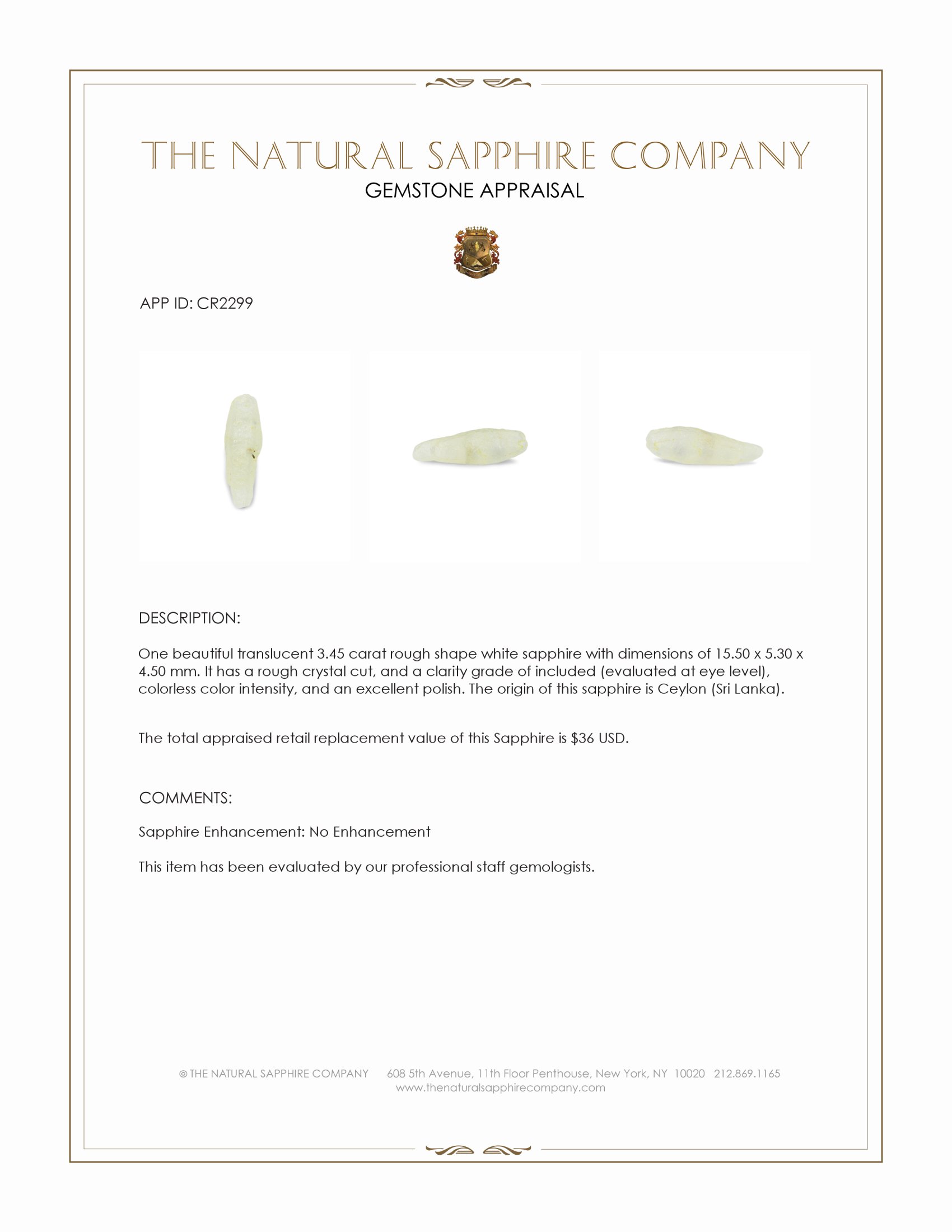
This 3.45 carat translucent white sapphire from Ceylon presents a rare combination of natural morphology and meticulous finishing, offered by The Natural Sapphire Company, The weight is 3.45 carats, the dimensions are 15.50 x 5.30 x 4.50 mm, the cutting style is a rough crystal cut in a various shape format, the clarity is graded included at eye level, the color is colorless in intensity, the surface polish is excellent, there has been no enhancement, and the origin is Sri Lanka. These baseline metrics define the objective character of the stone, and they also set the stage for a detailed technical assessment of its optical performance. The rough crystal cut preserves primary crystal faces and natural terminations rather than imposing a conventional faceted geometry, and this structural choice produces a distinct interplay between light and matter that is different from that of conventionally faceted white sapphires.
At the level of crystal physics, corundum exhibits a high refractive index and measurable birefringence, and these properties govern how incident light is partitioned between refracted, reflected, and internally scattered components. The refractive index regime of sapphire concentrates light within the crystal lattice, and the preserved crystal planes in a rough crystal cut act as mirror like interfaces that return light along predictable vectors. The various shape profile, with its elongated 15.50 mm length and comparatively shallow 4.50 mm depth, creates an optical path length that favors repeated internal reflections along the long axis, enhancing scintillation when the stone is set to allow lateral light entry. The excellent polish executed on the preserved faces reduces micro scattering at the surface, which in turn increases the proportion of light that undergoes total internal reflection and returns to the observer as concentrated brightness. Because the stone is colorless, there is minimal chromatic absorption across the visible spectrum, so the perceived sparkle is dominated by pure white flashes of light rather than colored dispersion, and that yields a clean, lively appearance that is prized in high quality white sapphires.
Inclusions in this specimen are classified as included at eye level, and rather than detracting from performance, certain inclusion morphologies interact with the crystal geometry to produce localized scattering centers that contribute to dynamic scintillation. Platelets, healed fractures, or fine mineral needles within corundum can act as micro reflectors when oriented with respect to the preserved faces, producing intermittent flashes as the viewing angle changes. The translucency of this stone permits a controlled amount of light transmission, so internal scatter is balanced with return, resulting in a sparkle pattern that is more three dimensional than that of fully transparent, conventionally faceted stones. The combination of an untreated colorless body, the rough crystal structural framework, and a superlative surface finish means that the angular distribution of returning light is tight and bright, imparting a perceived intensity to highlights that is often described in quantitative terms as elevated brilliance and high contrast ratio, measurements that translate directly into visible pop and depth.
From a craftsmanship and practical standpoint, this white sapphire is engineered to perform in a variety of settings, and the untreated provenance from Ceylon enhances both market desirability and long term value. The rough crystal cut requires specialized setting techniques to secure the stone without obscuring its natural faces, and a well designed bezel or tapered prong arrangement will preserve the optical axes that generate the strongest returns. The hardness and toughness of corundum make it suitable for everyday wear, and because there has been no heat treatment or glass filling, the optical attributes you observe are stable and inherent to the crystal. For collectors and designers who prioritize structural origin, the combination of Sri Lankan provenance, no enhancement, and a preserved crystal habit creates an aesthetic and technical profile that is distinct from heat treated or fully faceted white sapphires. If you would like a detailed report, high resolution facet plane maps, or advice on setting geometry to maximize the stone specific light return, The Natural Sapphire Company can provide gemological documentation and bespoke design recommendations, ensuring that the unique sparkle of this specimen is realized in a finished piece.


