
- Stone13
- Reports3
-oval-pink-sapphire-0.4700-cts-s36768-1.jpg?d=200x200&v=20260218094643)
-oval-pink-sapphire-0.4700-cts-s36768-lifestyleimage-1.jpg?d=200x200&v=20260219030133)
-oval-pink-sapphire-0.4700-cts-s36768-lifestyleimage-2.jpg?d=200x200&v=20260219030133)
-oval-pink-sapphire-0.4700-cts-s36768-lifestyleimage-3.jpg?d=200x200&v=20260219030133)

-oval-pink-sapphire-0.4700-cts-s36768-1.jpg?d=750x750&s=nsc&v=20260218094643)
-oval-pink-sapphire-0.4700-cts-s36768-lifestyleimage-1.jpg?d=750x750&s=nsc&v=20260219030133)
-oval-pink-sapphire-0.4700-cts-s36768-lifestyleimage-2.jpg?d=750x750&s=nsc&v=20260219030133)
-oval-pink-sapphire-0.4700-cts-s36768-lifestyleimage-3.jpg?d=750x750&s=nsc&v=20260219030133)

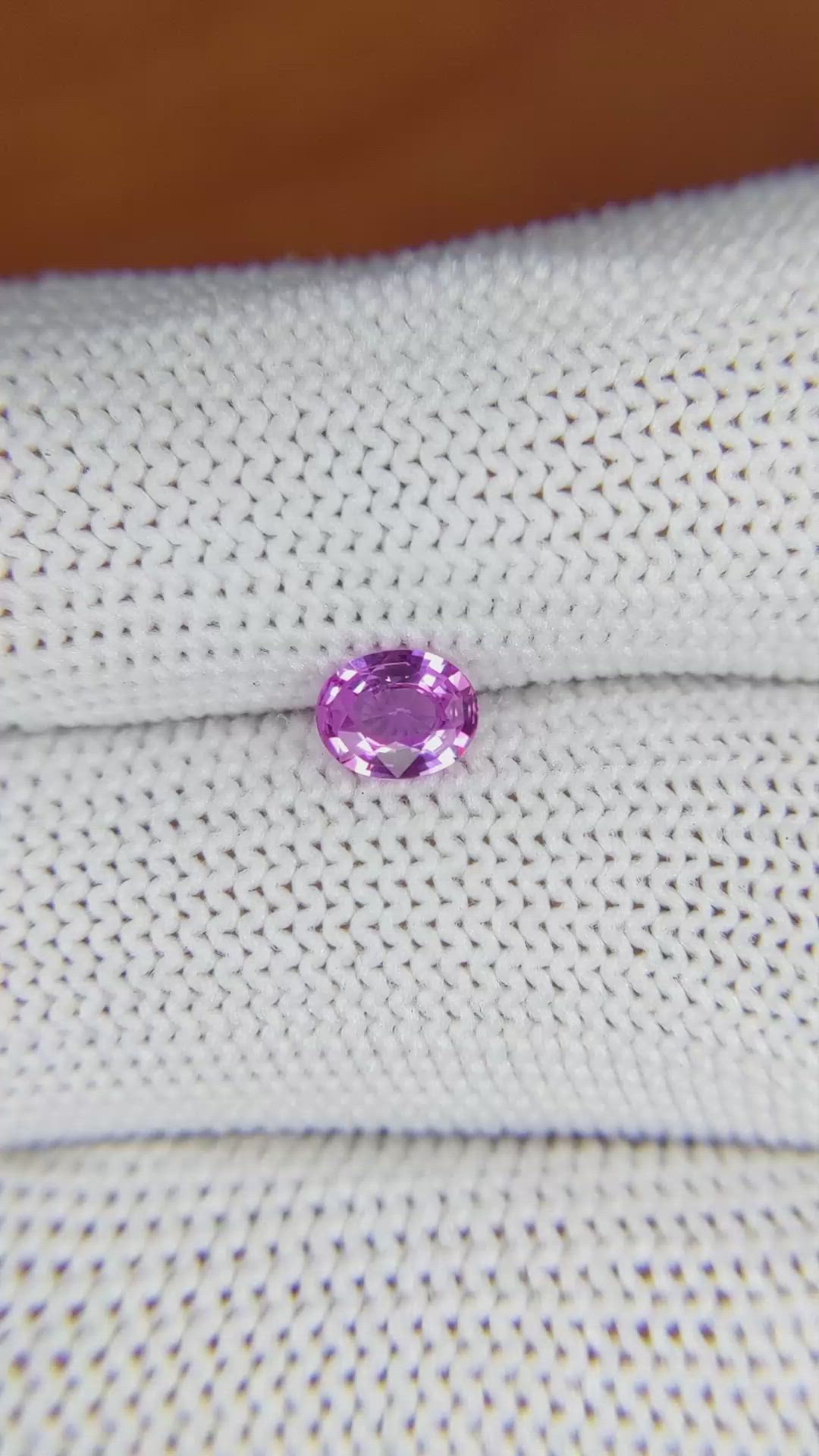
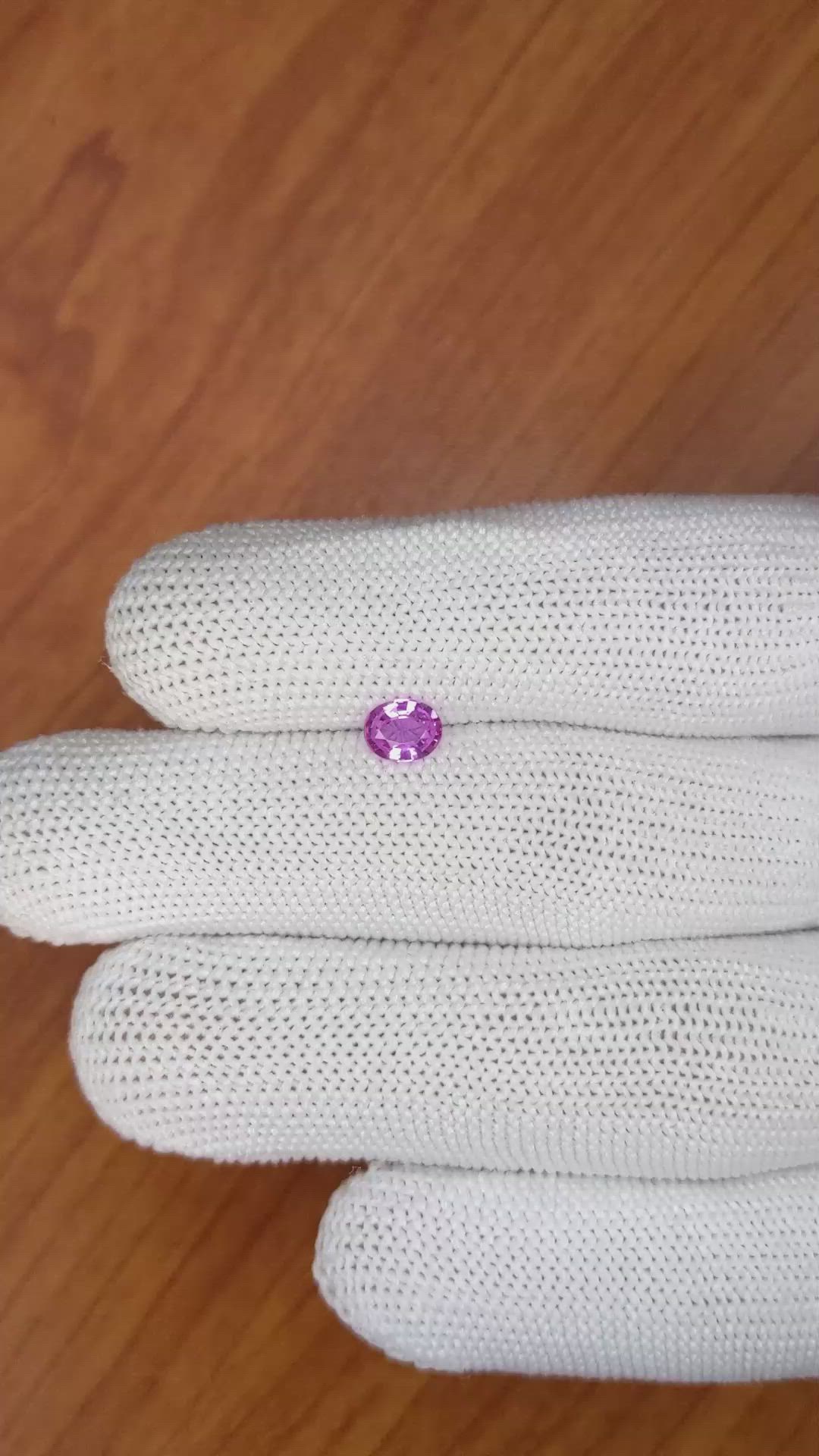
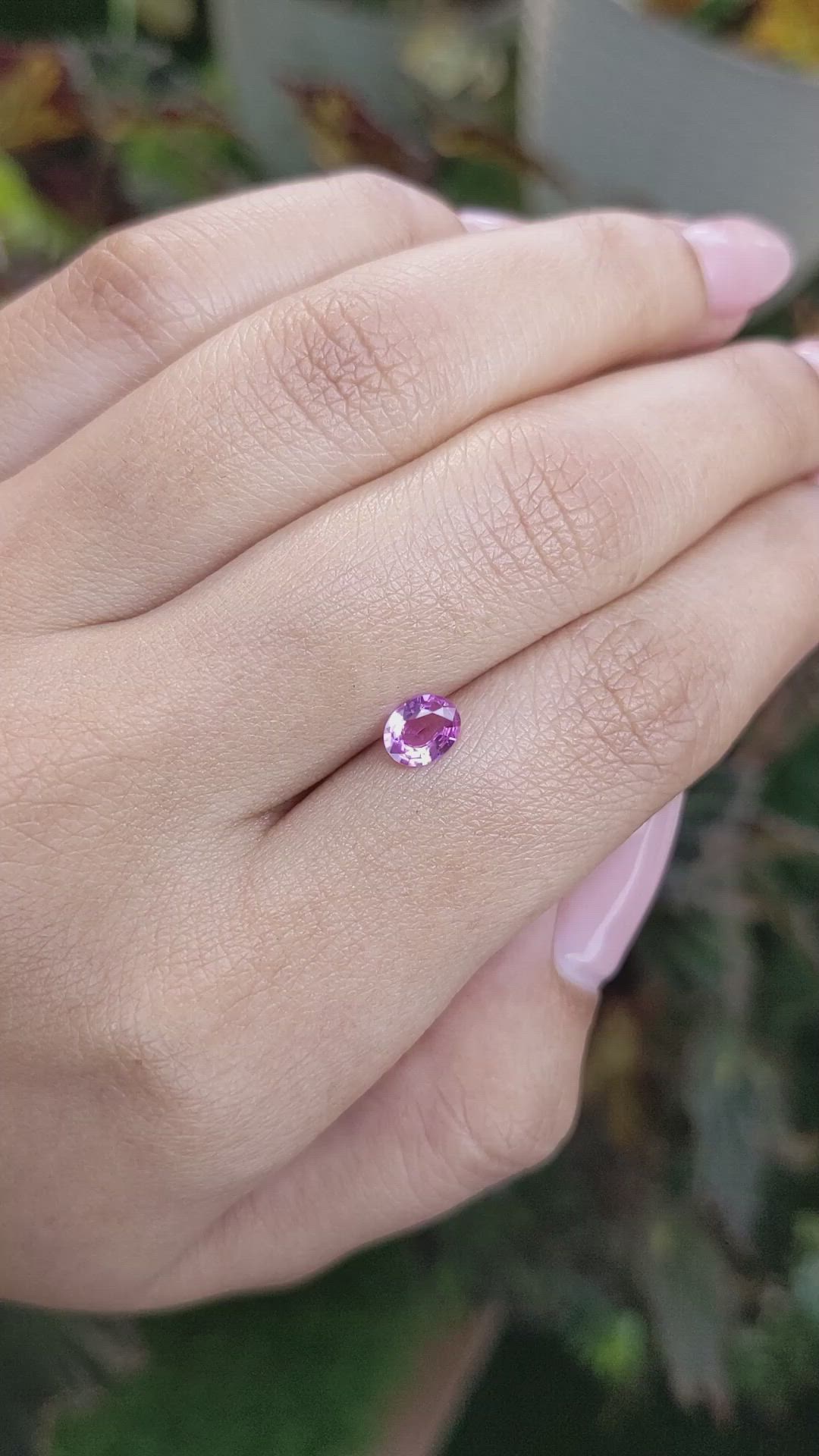
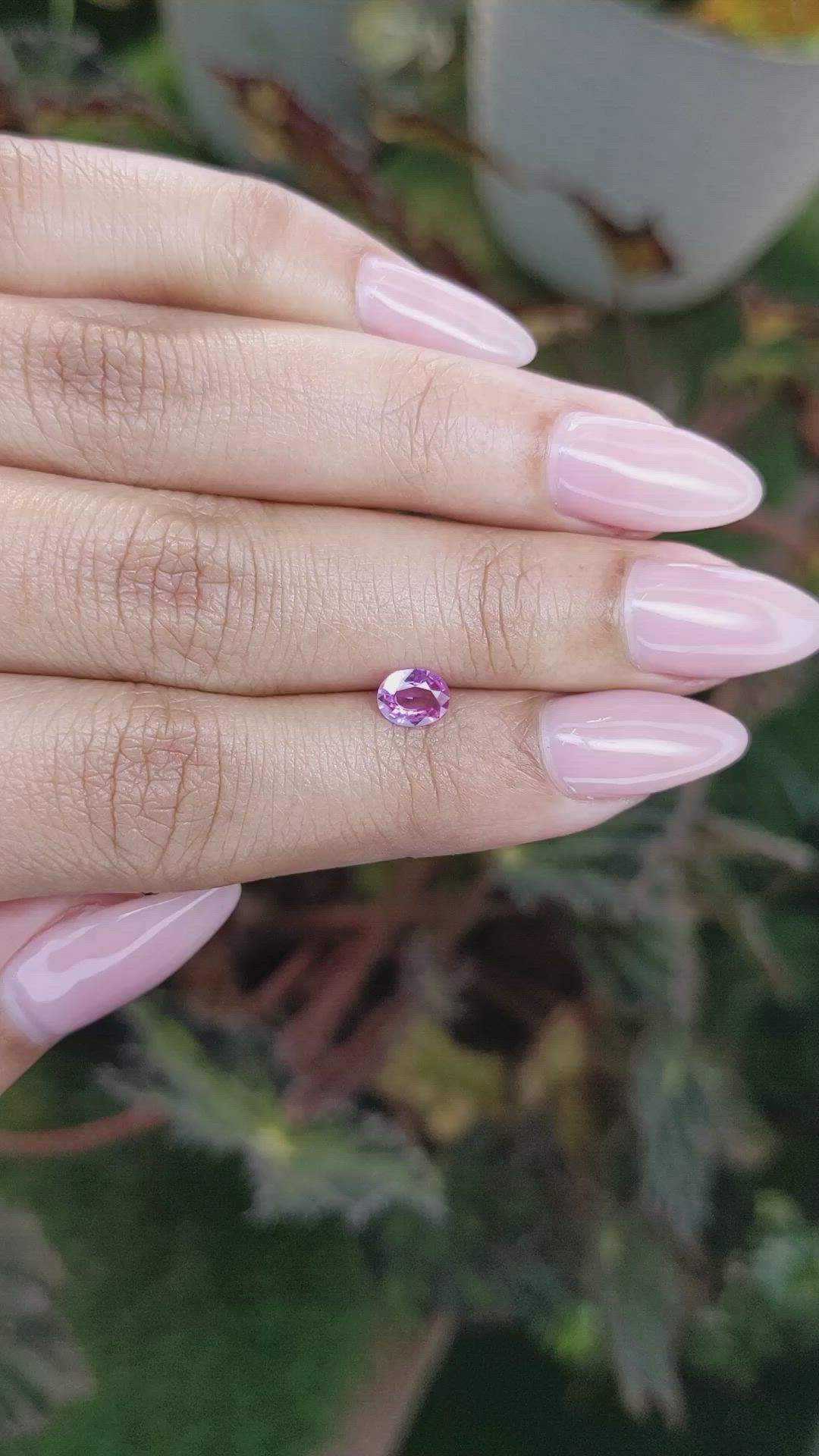
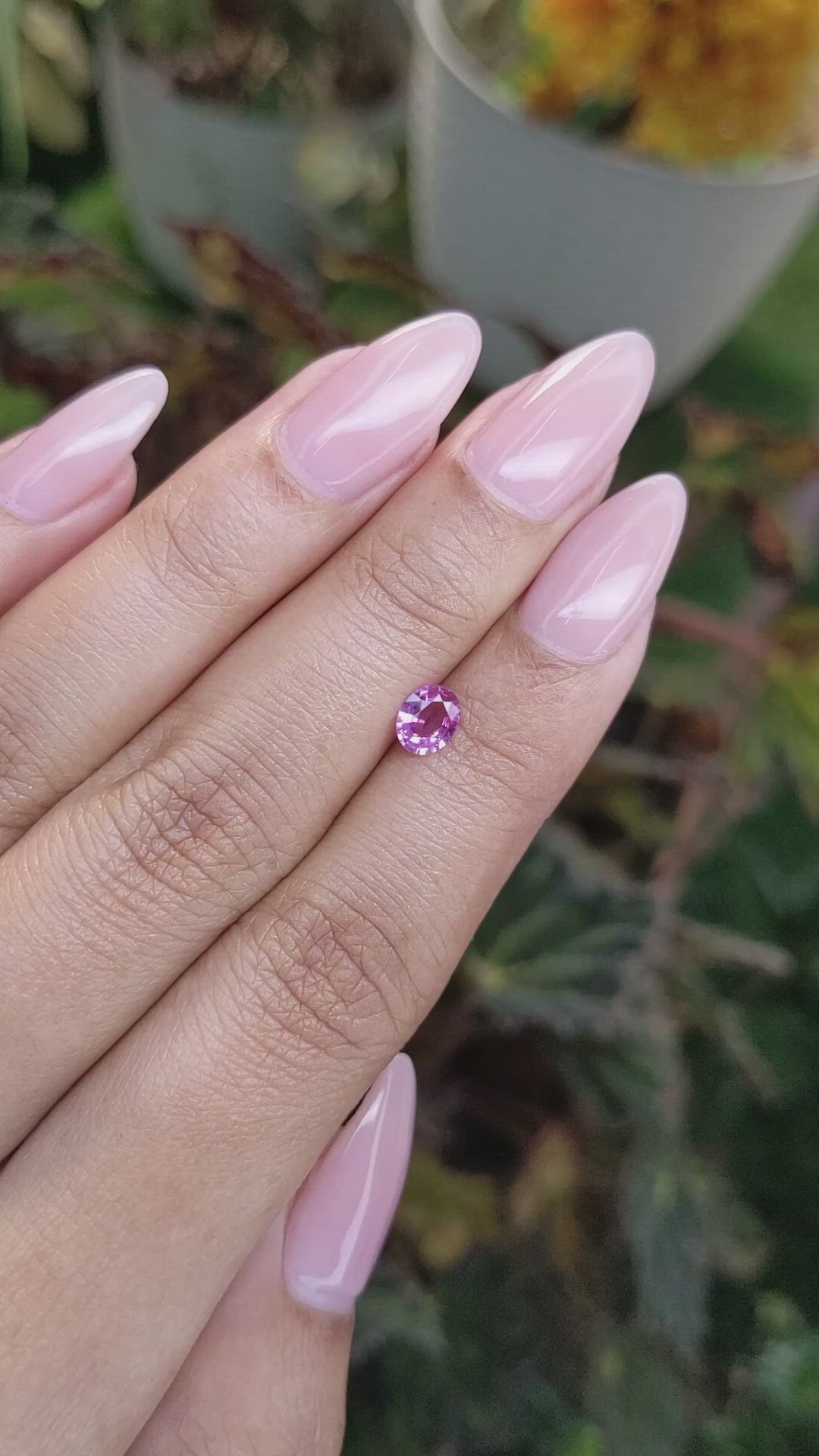
0.47 Ct. Pink Sapphire from Ceylon (Sri Lanka)
This loose stone is available to ship now
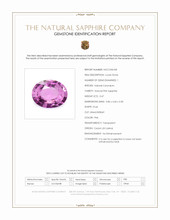
Item ID: | S36768 |
|---|---|
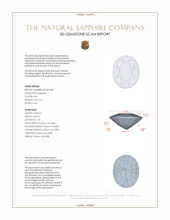
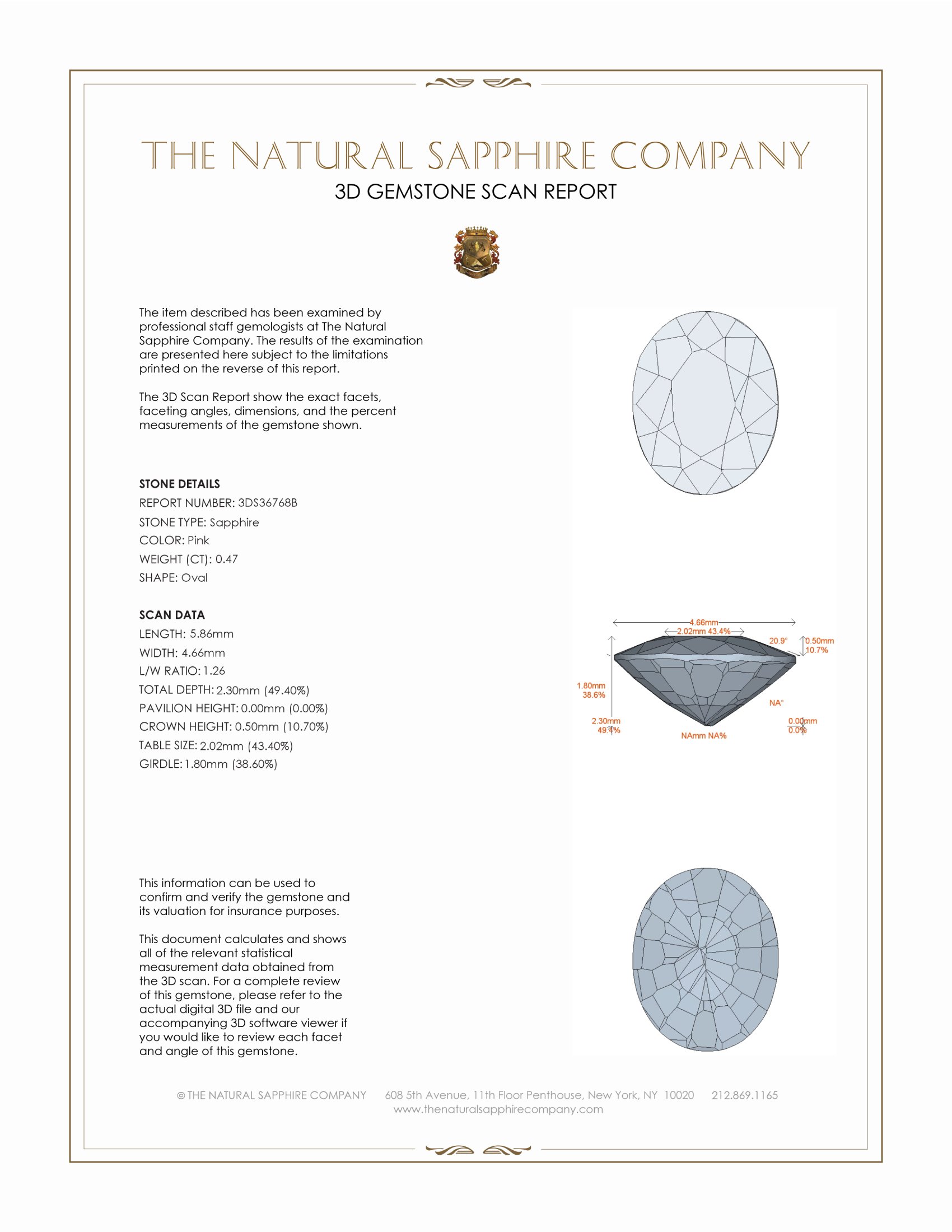
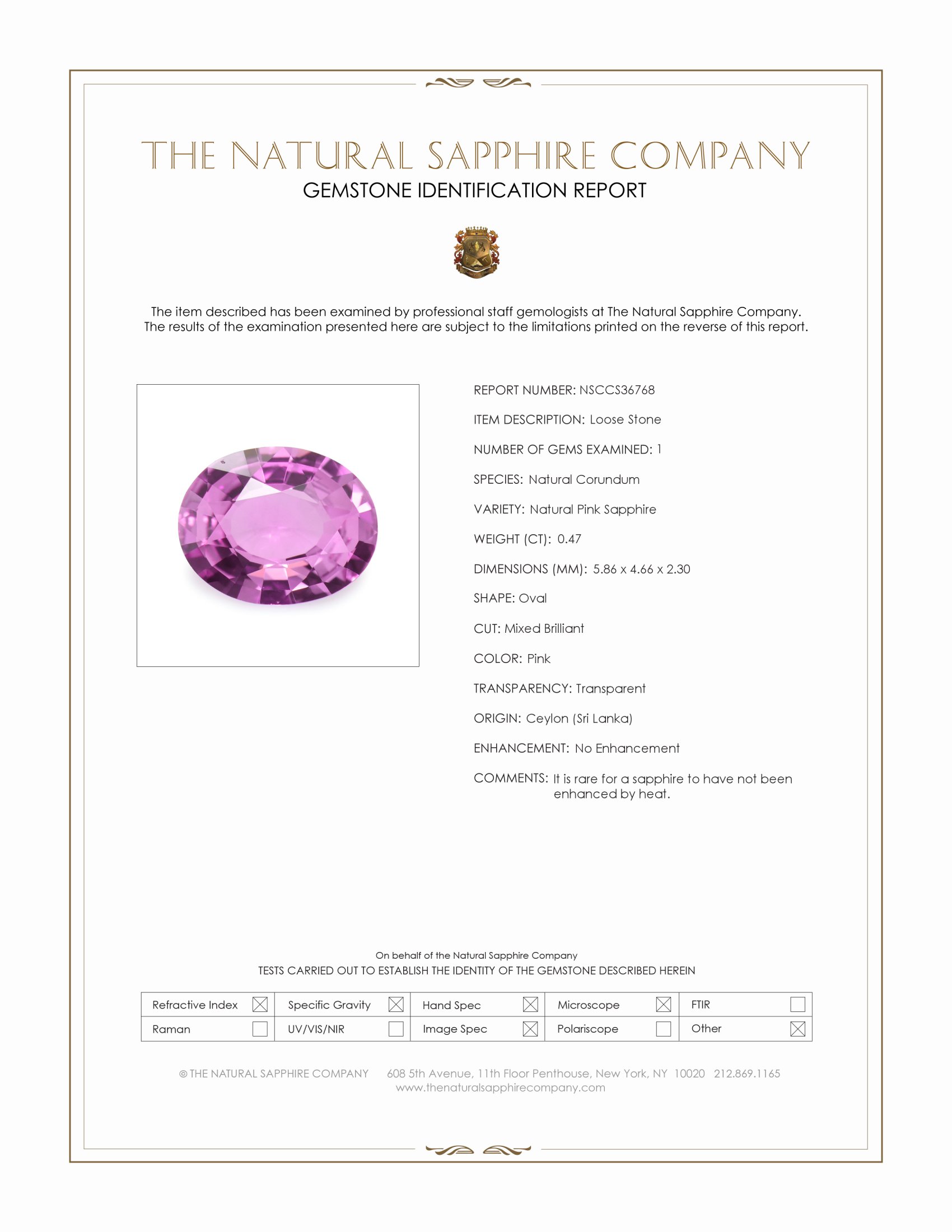
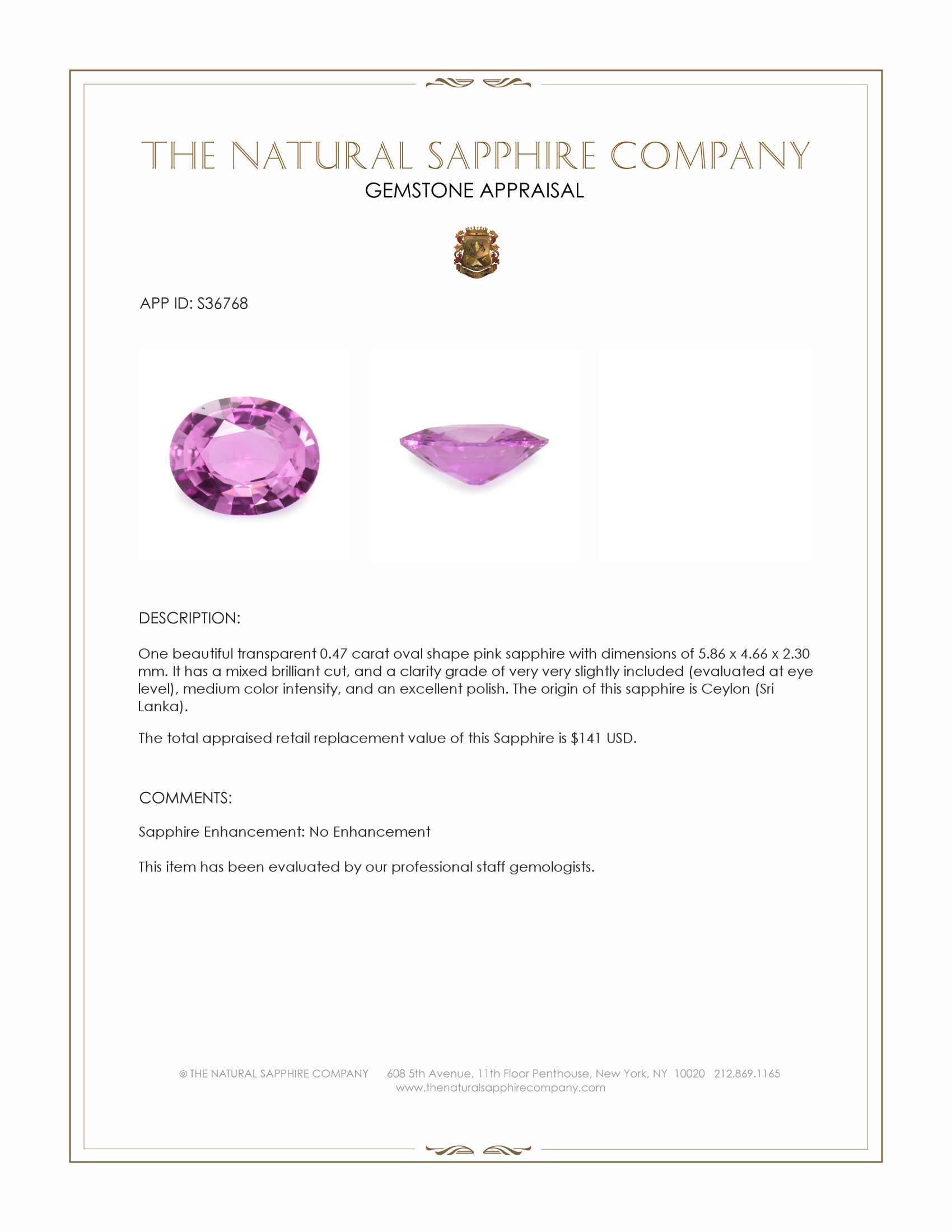
Dimensions (MM): help | Length: 5.86 Width: 4.66 Height: 2.3 |
Weight: | 0.47 Ct. |
Color: help | Pink |
Color intensity: help | Intense |
Clarity: help | Very Very Slightly Included |
Shape: help | Oval |
Cut: | Mixed Brilliant |
Cutting style: | Faceted |
Enhancements: help | No Enhancement |
Origin: help | Ceylon (Sri Lanka) |
Per carat price: help | $300 |
This 0.47 carat oval pink sapphire presents a precise combination of dimensions and gemological quality, suitable for collectors and connoisseurs who value both optical performance and provenance. The stone measures 5.86 x 4.66 x 2.30 mm, and its mixed brilliant cut has been executed to balance lively brilliance with well defined color distribution. Clarity is described as very very slightly included, evaluated at eye level, and the transparent nature of the crystal plane allows for direct examination of internal features without impairment to light return. Color is intense, a saturation level that reads as a vivid pink under standardized daylight viewing, and the finish is of excellent polish, yielding crisp facet junctions and a highly reflective table. Enhancement status is none, which means this sapphire is offered in its natural state without heat treatment or other clarity or color modifications. Origin is Ceylon Sri Lanka, a historic source for corundum that imparts a recognized market desirability. At The Natural Sapphire Company we document these parameters and present this sapphire with accompanying provenance notes for assured authenticity.
The mixed brilliant faceting plays a central role in the gemological behavior of this oval, the cutting strategy combining a brilliant style crown with pavilion facets optimized to manipulate corundum refractive characteristics. Corundum has a refractive index in the range of about 1.760 to 1.778, and the cutter has adjusted crown and pavilion angles to account for this index, maximizing internal reflection and minimizing light leakage through the girdle. The oval geometry adds a length to width ratio that enhances perceived size while maintaining proportional symmetry, and careful alignment of the table facet preserves a clean window into the pavilion. Mixed brilliant executions often incorporate a modified brilliant pavilion, producing lively scintillation and a balanced pattern of light and dark areas that complement the intense pink hue. Surface finishing is crucial, and the excellent polish on this specimen minimizes surface scattering and allows strong specular highlights. In practical terms this means the sapphire will exhibit efficient light return in jewelry settings that do not overly shadow the pavilion, and it will sustain long term surface integrity due to corundum hardness at Mohs grade 9.
Clarity and internal characteristics are informative for both aesthetic appreciation and gemological identification, the very very slightly included grade at eye level indicating minimal visible inclusions under standard viewing conditions. Natural inclusions in corundum can include fine needle rutile, mineral crystal pockets, fingerprint or healed fracture networks, and these features serve as a microscopic fingerprint of natural growth. In this sapphire the internal map is sparse, enhancing transparency and allowing the intense pink color to present without significant obstruction. Optical phenomena related to structural anisotropy, such as pleochroism, are present in corundum and can produce subtle shifts from purplish pink to orangey pink when the stone is rotated under light, a behavior that knowledgeable setters can exploit in orientation to emphasize preferred color faces. The absence of enhancements means inclusions are unaltered by clarity filling, preserving the stone in its geologically formed state, and this is an important factor for buyers focused on natural integrity and long term valuation.
When comparing this natural Ceylon pink sapphire to lab grown alternatives, the technical distinctions are clear and relevant to informed buyers. Lab grown corundum typically displays a high degree of uniformity in color and often fewer inclusions, because growth conditions are controlled and impurities can be minimized. This yields visually clean stones at more accessible price points, and modern hydrothermal or flux growth processes can replicate color centers seen in natural material. However, natural stones like this Sri Lankan sapphire record a complex growth history in their trace element palette, with chromium, iron, and titanium distributions imparting hue, tone, and saturation in ways that are rarely identical to synthetic production. Natural inclusions form unique three dimensional patterns and zoning, and these features provide objective markers for gemological identification using microscopy and spectroscopy. From a technical standpoint natural material also carries provenance signals, such as isotopic and trace element fingerprints associated with a Sri Lankan geological environment, which can be confirmed by advanced testing. In markets where rarity, historical origin, and long term collectibility are important, these attributes tend to preserve value more robustly than lab grown counterparts, even when initial visual appearance is similar.
For buyers who prefer verified natural material and technical precision in presentation, The Natural Sapphire Company offers this 0.47 carat oval pink sapphire as a specimen that combines desirable optical performance with documented origin and treatment status. The Ceylon provenance typically delivers a balance of saturation and clarity that is sought after in pink sapphires, and the lack of enhancement assures that the stone is in its native condition. In practical jewelry design considerations, an oval mixed brilliant with these dimensions benefits from settings that allow light entry to the pavilion, such as four or six prong configurations or open halo designs that do not overly mask the girdle. For collectors who plan to evaluate long term investment potential, the natural growth signatures and origin documentation are significant, and for custom jewelers the excellent polish and refined facet junctions reduce post setting finishing work. Our team can provide microscopy images and gemological reporting on request, and we accompany each natural purchase with advisory guidance on care, recommended setting orientations, and comparative analysis versus lab grown options, in order to support an informed acquisition that aligns with the technical priorities of experienced buyers.


