
-oval-blue-sapphire-3.0700-cts-s22668-1.jpg?d=200x200&v=20250324121510)

- Stone18
- Setting5
- Reports4
-oval-blue-sapphire-3.0700-cts-s22668-lifestyleimage-1.jpg?d=200x200&v=20250325015604)


-oval-blue-sapphire-3.0700-cts-s22668-1.jpg?d=750x750&s=nsc&v=20250324121510)

-oval-blue-sapphire-3.0700-cts-s22668-lifestyleimage-1.jpg?d=750x750&s=nsc&v=20250325015604)




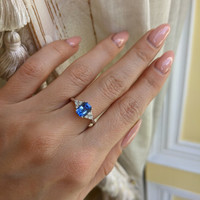
Accent Stones Blue Sapphire Ring 3.07 Ct., 14K White Gold



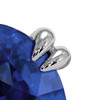
Wax Polymer Replica
Model of your Completed
Setting Design!

View 360° media
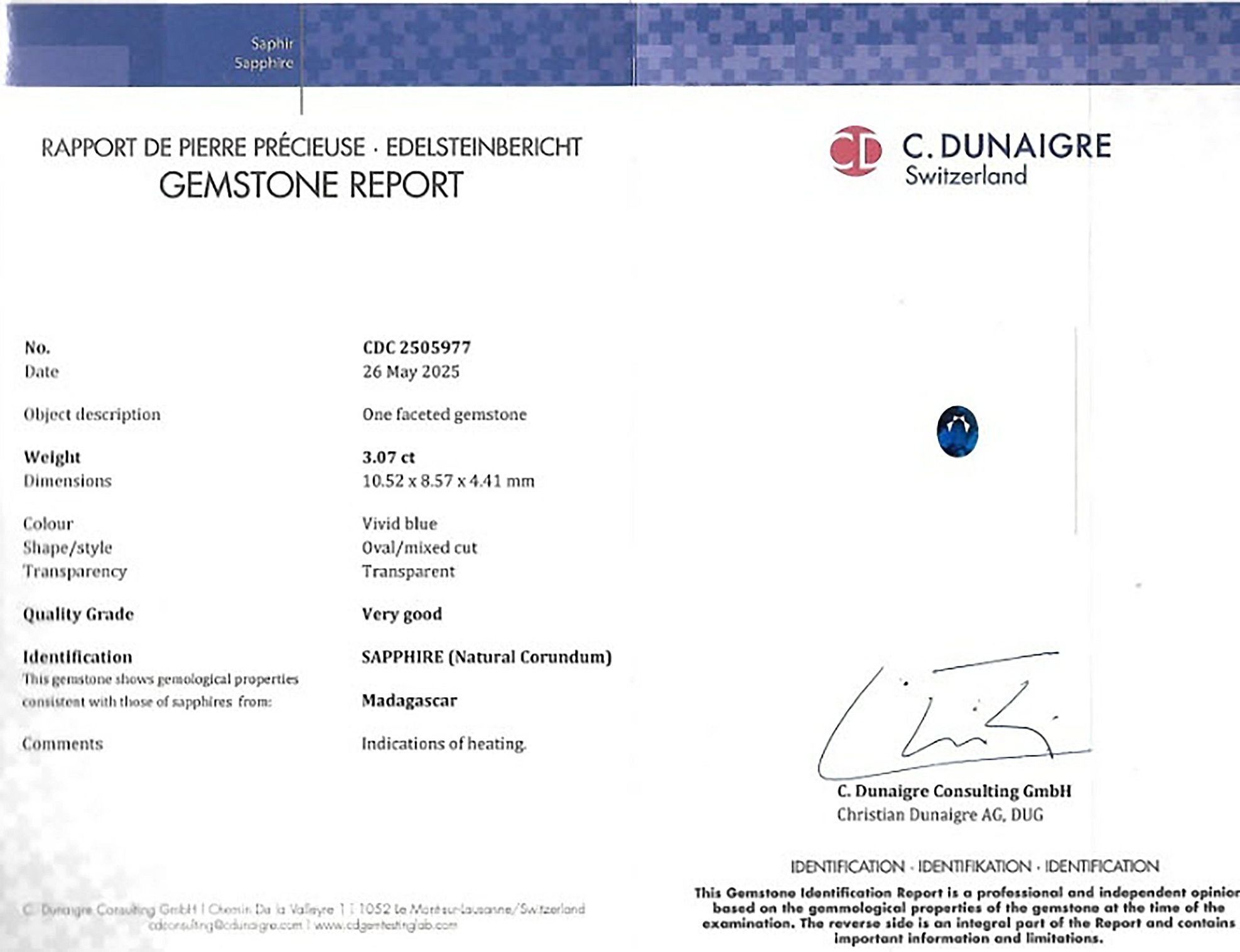
Item ID: | S22668 |
|---|---|
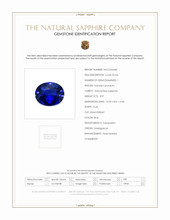
Dimensions (MM): help | Length: 10.53 Width: 8.61 Height: 4.42 |
Weight: | 3.07 Ct. |
Color: help | Blue |
Color intensity: help | Vivid |
Clarity: help | Eye Clean |
Shape: help | Oval |
Cut: | Mixed Brilliant |
Cutting style: | Faceted |
Enhancements: help | Heat Treated |
Origin: help | Madagascar |
Per carat price: help | $5,940 |
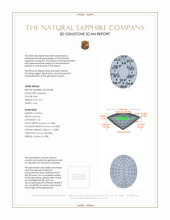
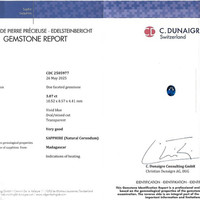
This transparent C.Dunaigre certified Vivid Blue sapphire, weighing 3.07 carats, presents as a classic oval, measuring 10.53 x 8.61 x 4.42 mm, and is offered to collectors and connoisseurs by The Natural Sapphire Company. The combination of size and face up dimensions yields an impressive visual presence relative to its carat weight. The grade of Vivid Blue denotes both intense saturation and a balanced medium to slightly deep tone that reads as a pure, true blue under standard daylight photographic lighting. Clarity has been evaluated at eye level and graded as eye clean, meaning no inclusions detract from the gem without magnification, and the finish is described as excellent polish, with crisp facet junctions and a smooth pavilion and crown that maximize transmitted light. The stone carries full disclosure of heat treatment, a stable and industry accepted enhancement that has been applied to optimize color and clarity, and the accompanying C.Dunaigre report documents the gemography and measurements for provenance and quality assurance.
Technically the stone is cut as a mixed brilliant oval, a faceting strategy that combines a brilliant style crown, often with triangular and kite facets radiating from a dominant table, and a modified pavilion that may incorporate step or mixed facets to balance weight retention and optical performance. The measured depth of 4.42 mm translates to a depth ratio of approximately 46 percent when calculated against the average diameter of 9.57 mm, a proportion that characterizes a shallower pavilion profile. This shallow profile expands the table and enhances face up spread, producing a larger apparent size on the finger or in a setting, and biasing the optical performance toward strong, uniform color face up rather than maximal fire or scintillation that deeper proportions would emphasize. The mixed brilliant architecture in this oval has been executed to align pavilion facet angles and crown heights for optimal light return, and the excellent polish and precise facet junctions reduce light leakage and surface diffusion, resulting in a clean, velvety face up appearance that many technical buyers specifically seek.
Color and clarity interact in this specimen to produce the vivid blue classification. The gem exhibits a saturated blue hue with limited secondary modifiers, and the vivid intensity indicates a high level of chroma while maintaining a clarity that allows internal light pathways to be effective. From a gemological perspective the blue color mechanism is consistent with iron titanium intervalence charge transfer, and the trace element profile commonly observed in Madagascan corundum produces a strong, electrically mediated absorption banding that yields pure blue tones without pronounced green or purple modifiers. The eye clean clarity grade implies that any common microscopic rutile silk or tiny mineral inclusions are minimal and dispersed, serving at most to soften light leakage and contribute to a slightly velvety texture rather than producing visible reach or feathering at normal viewing distances. Heat treatment has been applied in a controlled manner to stabilize and intensify the blue, and this treatment is permanent under standard wear. The combination of vivid chroma and transparent body color allows the stone to read richly saturated under both daylight and artificial light, with excellent color uniformity across the oval field.
The stated origin of Madagascar carries both geological and market significance and it meaningfully adds value for knowledgeable buyers. Madagascar is a relatively recent but prolific source of high quality corundum, with deposits that often yield stones displaying saturated, pure blue hues and high transparency reminiscent of the best of the modern sapphire markets. The provenance from Madagascar, as documented by the certification and The Natural Sapphire Company provenance practices, informs collectors about the trace element chemistry and typical inclusion suites they can expect, and it also situates the sapphire within a well respected supply chain for contemporary top quality material. From a craftsmanship standpoint the cutter has balanced weight retention with optical considerations, preserving 3.07 carats while delivering an expansive face up area and a vivid color that benefits from the island provenance. For setting recommendations this sapphire will perform exceptionally well in a medium to low bezel or open gallery setting that showcases its face up color and allows light to enter the broad table, and routine care with gentle cleaning solutions and a soft brush will preserve the excellent polish and saturation. The Natural Sapphire Company provides the C.Dunaigre report and full disclosure on heat treatment and origin, offering technical documentation and provenance that collectors and designers rely upon when selecting a premium Madagascar vivid blue sapphire.
This custom made ring setting is engineered to present a central gemstone with maximum optical performance, available in a broad selection of precious metals for precise aesthetic and mechanical preferences, including 14K rose gold, 18K rose gold, 14K white gold, 18K white gold, 14K yellow gold, 18K yellow gold, platinum 950, 14K white and yellow, 18K white and yellow, 14K yellow and white, 18K yellow and white. The design style employs accent stones placed strategically around the center stone to enhance perceived size and increase total light return, while the side stone type is diamond, set in classic round shapes to complement common center stone cuts. The setting geometry is intended to accept sapphires, rubies, emeralds, and a wide range of other gemstones, with a multi prong head that secures the center stone and an engineered gallery that maintains open facets for optimal light entry and dispersion. Proportion and balance are key elements of the design, the band tapers subtly toward the head to direct visual focus to the center, while the shoulder thickness is calibrated to provide structural integrity without impeding the optical field around the centerpiece.
The accent stones style is technical in its approach to halo and flanking placement, with small round brilliant diamonds set in pairs along the shoulders to frame the center stone and to create graduated scintillation that radiates outward. Each round accent is selected for precise cut quality to maximize brilliancy, and the setting uses micro prong and bead techniques to reduce visible metal while maintaining secure retention, the result is a continuous surface of light punctuated by well defined bezels of reflection. Faceting considerations for the side diamonds are specified to harmonize with the center, round brilliant accents are matched for pavilion and crown proportion so that facet intersections catch and redirect light in a coherent manner, this avoids visual discord that can occur when disparate facet patterns are adjacent. The technical spacing between accent stones is engineered to preserve local color balance and to prevent light leakage at the girdle line of the neighboring stones, each seat is precisely milled to align girdles on a single plane, and crowns are trimmed to maintain predictable table reflections that amplify the central gemstone without overwhelming it.
Craftsmanship techniques used in the execution combine modern workflow and traditional hand finishing to produce a ring that is both precise and tactile, the initial design is modeled in CAD to refine prong geometry and to verify stress points under simulated wear, subsequent rapid prototyping and lost wax casting yield a near net shape that is carefully chased and refined by hand. The prongs are burnished and internally stress relieved, corners are radiused where necessary to reduce contact points that can chip sensitive stones such as emeralds. Metal selection influences finishing protocols, white gold receives rhodium plating to achieve high contrast and reflective return around colorless diamonds, rose gold alloys are chosen for their copper content to enhance warm undertones that complement rubies and certain sapphires, platinum 950 is recommended for maximum long term resilience and for patrons who prefer a naturally white metal that will not require plating. Dual tone options are constructed using mechanical joins that maintain metal continuity and avoid galvanic seams, these two tone executions are milled and fitted prior to final polishing to ensure seam visibility remains below optical thresholds.
This setting transforms any compatible gemstone into an elegant and timeless masterpiece by addressing optical, mechanical, and aesthetic variables with calibrated solutions, for colored gemstones the accent diamonds are chosen in color ranges that either contrast to boost perceived saturation or match to preserve a cool neutral field, typical diamond color grades for this application range from D to H depending on budget and desired contrast, and clarity targets are commonly VS1 to SI1 to balance apparent purity with cost effectiveness, the round side diamonds act as light amplifiers, the halo and shoulder cluster create a luminous bezel that increases perceived diameter and creates a classic silhouette. The adjustable prong head can be tailored to accept round, oval, cushion, or emerald cuts, with prong geometry adapted to protect pavilion tips and to allow optimal girdle clearance, the gallery architecture creates a visible aperture beneath the center stone that invites light and allows easy inspection and cleaning, while maintaining a low profile that supports everyday wear. Routine care recommendations include professional ultrasonic cleaning for metal and diamonds at regular intervals, inspection of prong tightness annually for high use wearers and gentle hand cleaning between service sessions to maintain maximum brilliance, when specified with high durability metals and properly selected center stones this setting will retain proportions and visual language for generations, making it an investment in both form and function.


