
- Stone14
- Reports3
-asscher-octagon-blue-sapphire-2.5800-cts-s15708-1.jpg?d=200x200&v=20250421063808)
-asscher-octagon-blue-sapphire-2.5800-cts-s15708-lifestyleimage-1.jpg?d=200x200&v=20240819004634)
-asscher-octagon-blue-sapphire-2.5800-cts-s15708-lifestyleimage-2.jpg?d=200x200&v=20240819004634)
-asscher-octagon-blue-sapphire-2.5800-cts-s15708-lifestyleimage-3.jpg?d=200x200&v=20240819004634)


-asscher-octagon-blue-sapphire-2.5800-cts-s15708-1.jpg?d=750x750&s=nsc&v=20250421063808)
-asscher-octagon-blue-sapphire-2.5800-cts-s15708-lifestyleimage-1.jpg?d=750x750&s=nsc&v=20240819004634)
-asscher-octagon-blue-sapphire-2.5800-cts-s15708-lifestyleimage-2.jpg?d=750x750&s=nsc&v=20240819004634)
-asscher-octagon-blue-sapphire-2.5800-cts-s15708-lifestyleimage-3.jpg?d=750x750&s=nsc&v=20240819004634)


2.58 Ct. Blue Sapphire from Ceylon (Sri Lanka)
This loose stone is available to ship now
Item ID: | S15708 |
|---|---|
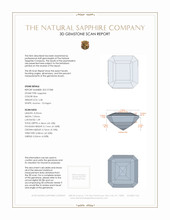
Dimensions (MM): help | Length: 8.25 Width: 7.59 Height: 4.18 |
Weight: | 2.58 Ct. |
Color: help | Blue |
Color intensity: help | Medium Intense |
Clarity: help | Very Slightly Included |
Shape: help | Asscher - Octagon |
Cut: | Asscher |
Cutting style: | Faceted |
Enhancements: help | Heat Treated |
Origin: help | Ceylon (Sri Lanka) |
Per carat price: help | $1,480 |
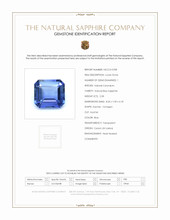
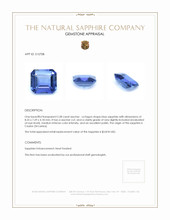
This listing describes a single, transparent 2.58 carat blue sapphire, asscher-octagon in shape, with precise dimensions of 8.25 by 7.59 by 4.18 millimeters. The gem is fashioned in an asscher cut, producing broad step facets and a defined, truncated square outline with clipped corners that read as an octagon in outline. Clarity is described as very slightly included, evaluated at eye level, producing an essentially eye-clean appearance that maintains strong face-up transparency. Color is classified as medium intense blue, with even saturation across the table and pavilion, and polish is graded excellent, yielding crisp facet junctions and smooth facet planes. The sapphire originates from Ceylon, Sri Lanka, and has been heat treated, an accepted and stable enhancement applied to optimize hue and clarity in corundum. The combination of carat weight, cut proportions, and finish results in a gem with notable presence, suitable for center-stone applications in rings and bespoke settings.
From an optical and gemological perspective, this Ceylon blue sapphire presents a type of brilliance that differs fundamentally from that of more commonly compared gemstones. Diamond, as the industry reference for brilliance, owes its scintillation and fire to a high refractive index and strong dispersion, producing numerous white flashes and spectral color flashes under mixed lighting. Sapphires, corundum species, have a lower refractive index and markedly lower dispersion, therefore they do not display the same kind of fire as diamond. Instead, the visual appeal of this sapphire is derived from its color saturation, internal transparency, and the way the asscher step cut organizes reflections. The result is a depth-rich, velvety luminance and broad mirror-like flashes that emphasize hue and tone rather than spectral dispersion. Compared with popular colored gems such as blue topaz, which can appear brighter but often more synthetic and lighter in tone, or aquamarine, which tends toward a paler, watery blue, this sapphire retains a concentrated blue that reads as more vibrant and saturated under ambient light.
The asscher cut contributes uniquely to the gem’s light performance. Where brilliant cuts maximize small, lively scintillation through numerous triangular and kite facets, the asscher produces larger, more architectural reflections. In this sapphire, the stepped crown and pavilion planes create a hall-of-mirrors effect, with repeating bands of deep blue and lighter blue that shift as the stone moves. Because sapphires exhibit dichroism, or pleochroism, the asscher step design can accentuate subtle directional color, yielding a dynamic but controlled change between blue tones rather than abrupt color shifts. The excellent polish ensures that facet intersections return light cleanly, and the eye-level assessment of very slight inclusions means the large table and facets present a clean visual field. Compared to spinel, which can deliver lively brilliance and a pure, glassy aesthetic, this sapphire’s brilliance is more about chromatic depth and reflective planes, a quality often preferred for classic, understated center stones.
Practical considerations for use and care reinforce the sapphire’s suitability for fine jewelry. Corundum rates nine on the Mohs scale, offering superior scratch resistance compared with most colored gemstones, and greater everyday resilience than topaz or softer gems. The heat treatment disclosed for this stone is a standard and stable enhancement used to achieve uniform color and improve clarity, especially common in Ceylon material, and does not detract from its suitability for permanent wearable settings. When set as a ring center, the 8.25 by 7.59 millimeter face-up dimensions combine with the asscher proportions to present a substantial visual footprint without exaggerating bulk, as illustrated in hand-view photographs. For those commissioning a bespoke mounting, the architectural lines of the asscher cut pair well with stepped or geometric metalwork, and the gem’s medium intense Ceylon blue will maintain visual presence in both natural and artificial lighting. The Natural Sapphire Company provides provenance and grading context that supports informed selection, and this stone exemplifies the combination of classic cutting, Ceylon origin, and measured optical character that collectors and designers often seek.


