
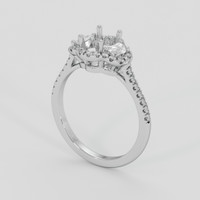
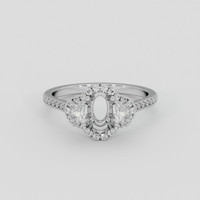
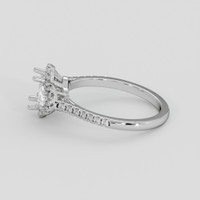
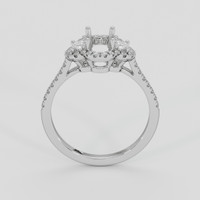


Platinum 950 Three Stone Ring Setting


This custom made ring setting offers exacting material choices and structural options, making it ideal for connoisseurs of gemology and meticulous design. The setting metal types available include 14K rose gold, 14K white gold, 18K white gold, 14K yellow gold, 18K yellow gold, and Platinum 950, each specified for its alloy properties and working characteristics. Rose gold presents warm copper tones and a moderate hardness that holds fine prongs well. White gold can be supplied in 14K or 18K and is typically finished with rhodium plating to optimize white light return and surface durability. 14K yellow gold and 18K yellow gold retain historic warmth and deep color saturation while providing different ductility and resilience for prong formation. Platinum 950 offers superior density and lower malleability, ideal for secure prong cups and long term wear, and it reduces metal loss around gemstones that are frequently cleaned. Center stone options include natural sapphire, ruby, emerald, or other gemstones chosen for cut, carat, and color grade, and the configuration accepts a central pavilion and crown geometry tailored to the chosen stone, with seat dimensions and prong geometry ground to micron tolerances for precise table alignment.
Accent stones style is executed by setting smaller gemstones in close proximity to the center stone, and these accent stones are used to enhance the perceived size, color contrast, and brilliance of the primary gem. In this ring the accent arrangement can be executed as microprong or bead set work around the halo and along the shank, with each accent calibrated for size, facet alignment, and girdle uniformity. Precision in faceting styles for accents matters, because small brilliant cut stones depend on consistent pavilion angles and crown heights to reflect light back through the table rather than leaking light through the girdle. Color grade matching is specified for compatibility, with diamonds selected within a tight color and clarity window where applicable, and colored accents matched for hue and saturation so as not to create unwanted color contamination against a sapphire, ruby, or emerald center. Side stones are provided as 4 half moon shapes, and half moon side stones feature a mixed faceting scheme that combines a straight girdle edge for seat stability with curved brilliant facets to transition light smoothly into the adjacent halo, providing a neatly dovetailed visual flow from center to shoulders.
The three stone style places three gemstones in a linear or gently curved axis, creating a balanced profile and often symbolizing the past, present, and future, and the technical execution requires symmetry in carat weight equivalence and optical balance. The center keystone will typically have crown and pavilion geometry optimized for maximum return, while the two lateral stones are cut and oriented to complement dispersion and phase match across the table plane, and for colored gemstones this means aligning color zoning and pleochroic axes where relevant. The pave style deploys small diamonds or gemstones set in close proximity, and in this setting micro pave techniques are used with bead or mill grain retention, ensuring that the stones sit within a continuous plane with minimal metal visibility, creating a seamless visual field of scintillation. Pave execution requires spot faceting uniformity, consistent girdle thickness, exact seat depth, and precise stone indexing so that adjacent facets are in phase for coherent light return. The halo style comprises a ring of smaller stones surrounding the center gemstone, and a well engineered halo enlarges apparent diameter through optical magnification while adding refractive interfaces that increase perceived brilliance, and the halo also provides a protective buffer that reduces edge contact and concentrates prong thickness at strategic load bearing points. Technical considerations include halo inner diameter relative to center girdle, height of mounting to avoid shadowing of pavilion facets, and prong or bezel geometry to control light leakage and maintain secure settings for all halo stones.
Imagine the jeweler at the bench, a craftsman who inspects a chosen sapphire or ruby under a 10X loupe before it is seated, measuring its girdle diameter with a calibrated micrometer and confirming table parallelism and pavilion angle against a cut diagram. The jeweler prepares the prong cups by forming them with a precise radius corresponding to the pavilion girdle, then burnishes each prong base to produce a micro flange that stabilizes the stone mechanically before any final closing. For an emerald center, the setter will orient the jardin inclusions to maximize face up color and minimize stress risers by using low profile prong tips and slightly higher crown clearance to mitigate impact. Half moon side stones are carefully crescent set into custom seats milled into the shoulders so that their straight girdle edge seats flush against the band, while the curved edge complements the halo contour, and each of the four side stones is indexed so that facet junctions line up with the central stone axes. The jeweler sets pave and halo stones by placing them one at a time in a microscopic groove, using a sharp graver to form beads, then polishing the bead to a mirror finish to blend metal and stone seamlessly. Final inspections include a 10X loupe check for secure bezels and prongs, a light table assessment to confirm that the pavilion returns are coherent and bright, and a final polish that may include rhodium plating for white gold options or a warm satin on rose or yellow gold, ensuring a finish that matches the selected metal and the optical character of the center gemstone.

