
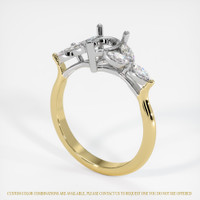
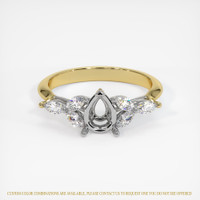
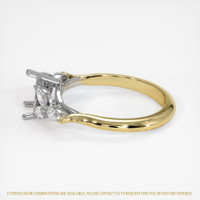
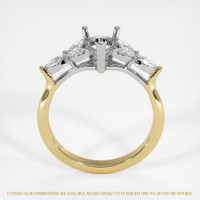
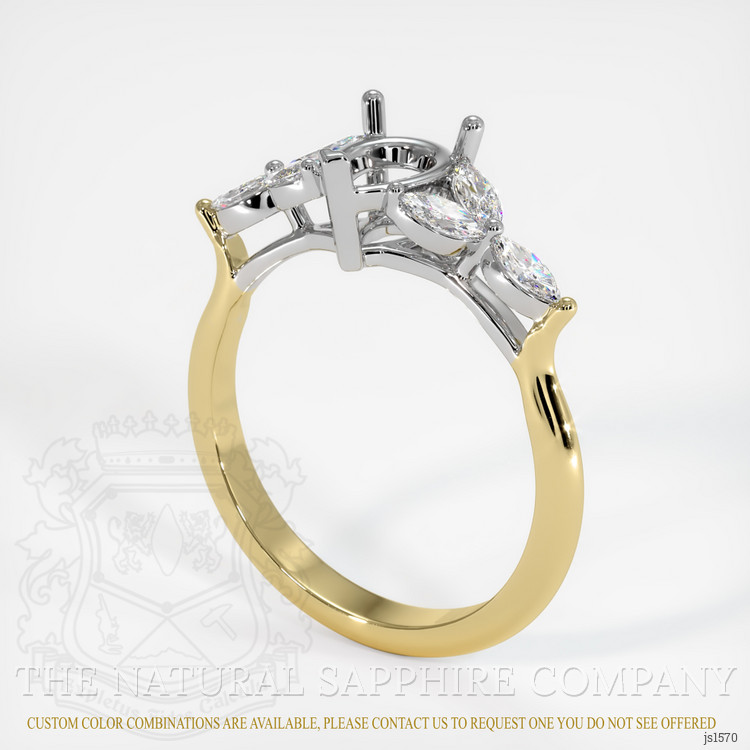
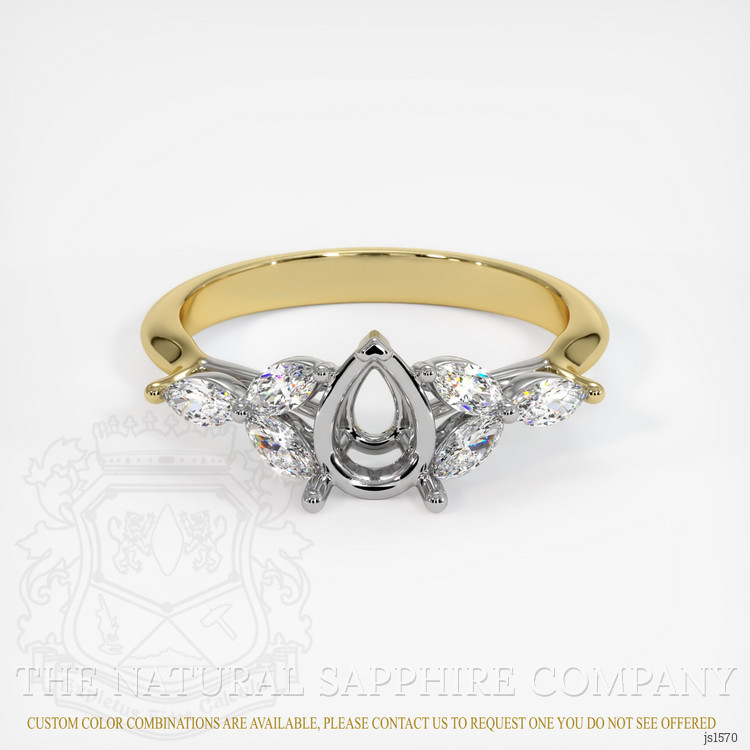
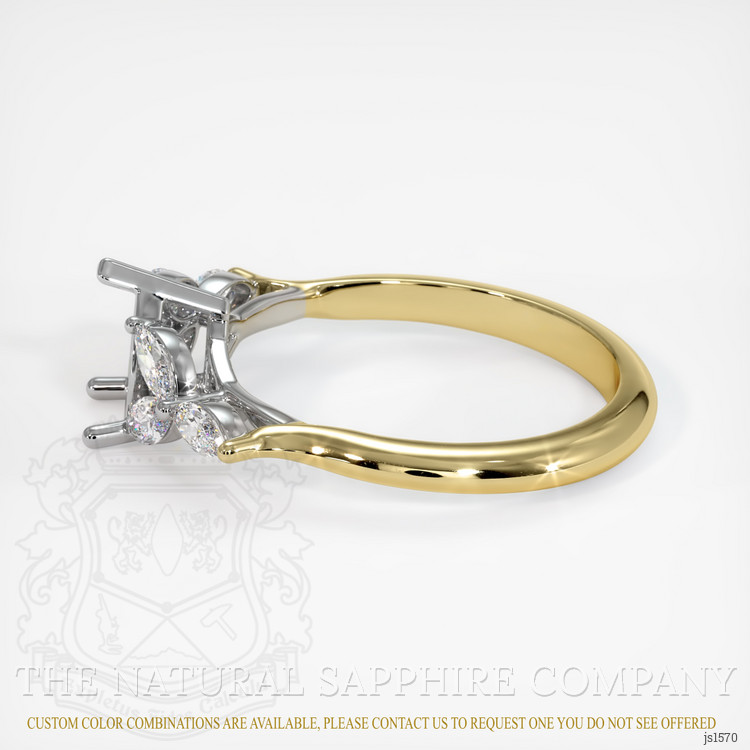
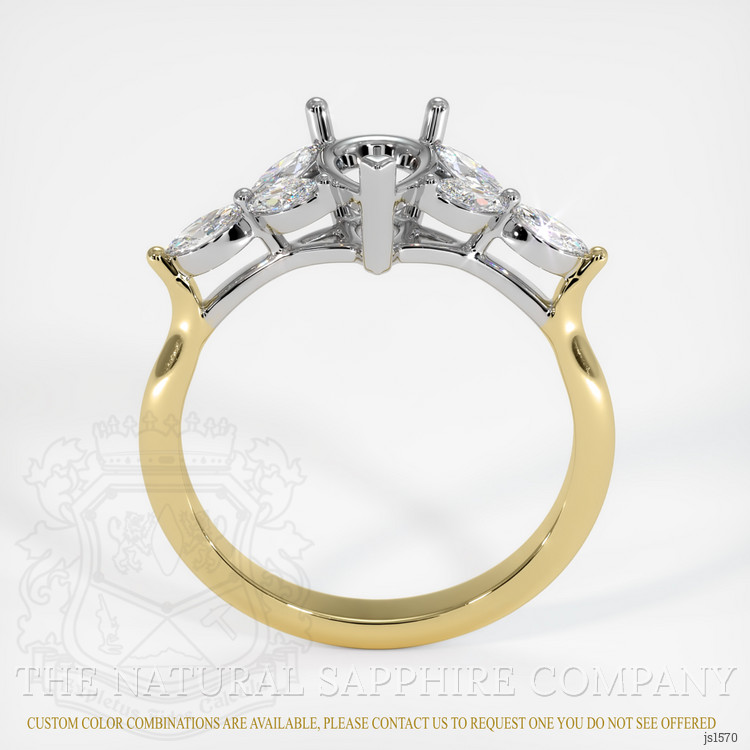

14K White & Yellow Accent Stones Ring Setting


This setting exemplifies the accent stones style, where smaller gemstones are set around the center stone to enhance its profile and add layered sparkle, and it is engineered to balance brilliance with structural integrity. The design incorporates four marquise side stones, deployed as two on each shoulder to frame the center, using marquise brilliant faceting to maximize scintillation while preserving the classic navette silhouette. Marquise stones are cut with elongated outlines and precise point profiles, with typical length to width ratios in the range of about 1.8 to 2.2 to maintain both elegance and stability. The points receive V style prongs or tapered protective prongs, depending on metal selection, to prevent chipping and to maintain clean lines where the marquise meets the shank. Accent stones that encircle the center are calibrated for matching fire and brightness, and may be faceted as round brilliant accents or as small pear or marquise accents to follow the center geometry, each stone indexed and graded for cut quality to ensure uniform light return across the crown.
The center stone options for this custom made ring setting include sapphire, ruby, emerald, or another preferred gemstone, and each species brings distinct considerations for cut, color grading, and setting technique. Corundum species such as sapphire and ruby allow for high brilliance cuts and tight prong profiles because of their Mohs hardness near nine, permitting more delicate claws and fine crown geometry that enhance the apparent size of the center stone without compromising security. Color grading for sapphires emphasizes hue purity and saturation, with velvety to vivid blues showing the deepest depth in medium to strong saturation levels, and for rubies warm red saturation with minimal brown or purple overtone indicates superior color grade. Emeralds require a different approach, with step cuts and mixed cuts often preferred to accentuate lush chroma while accommodating typical internal features, and setting strategies often include slightly more protective prong geometry or partial bezel elements to guard against impact. For all center stone species, the design supports pear shaped proportions naturally through the gallery and prong arrangement, and can be adapted to round, oval, or custom cuts, with stone seat tolerances held to a fine fit to avoid stress concentrations, while the proportions of side marquise stones are matched to the center to create visual harmony.
The setting metal options are comprehensive, with choices that include 10K, 14K, and 18K yellow gold, 10K, 14K, and 18K white gold, 14K and 18K rose gold, bicolor combinations in 14K and 18K white and yellow, platinum 950, and silver, and each metal selection is specified to influence hue, wear characteristics, and finishing processes. Eighteen karat gold offers richer color and a slightly softer matrix, making it favorable for high end color coordinated settings where deep rose or yellow tones are desired, while 14 karat alloys provide greater tensile strength and resilience for active daily wear. Rose gold contains elevated copper content to produce the warm salmon tones that complement pink and red gemstones, while white gold receives rhodium plating to produce a bright white appearance, with the understanding that periodic replating may be required. Platinum 950 is a dense, ductile option that resists wear and retains prong mass over time, beneficial for heavier gemstones or clients seeking hypoallergenic properties. Silver offers an economical route for proof of concept and for certain design aesthetics, but requires different polishing schedules and surface protection. The choice of metal also dictates prong thickness, collet geometry, and soldering parameters, and our CAD and casting specifications adapt metal shrinkage factors and annealing cycles to maintain dimensional fidelity.
The creation process begins with a technical sketch that captures the silhouette, prong architecture, and marquise placement, and proceeds into detailed CAD modeling where exact gemstone proportions are defined, light path analysis is performed, and under gallery geometry is optimized for both comfort and light return. From the digital model we produce a high resolution 3D print to serve as the master pattern, followed by traditional lost wax casting adapted to the selected alloy, and critical casting parameters are logged to ensure consistent grain structure and minimal porosity. Post casting, each seat is milled, and prong tips are preformed to the exact taper and radius required for the chosen stones. Hand setting is performed by master setters who use V prongs for marquise points, shared prongs where two stones meet, and bead setting or micro bead techniques for very small accents that form the halo effect around the center. All prongs are burnished and rounded to remove stress risers, and any bezel shoulders are flush filed and polished to precise surface roughness values. The ring receives sequential polishing operations, moving from medium to fine abrasives, followed by final high gloss polishing, and white gold pieces receive rhodium plating to specification. Laser soldering is used sparingly for repair and reinforcement without over annealing the metal, and the finished piece is subjected to loupe inspection, girdle to table alignment checks, prong torque assessment, and a stone security test before final QC packaging.
In final assembly the interplay of facets between the center and the marquise side stones is assessed to confirm harmonious optical performance, with side marquise lengths calibrated to approximately 40 to 60 percent of the center length to maintain proportion and to avoid visual competition, and with facet junctions intentionally aligned so that scintillation pulses cascade toward the finger for optimal perceived brilliance. Customers may specify precise faceting styles for the center, such as full brilliant, mixed cut, or step cut, and may request color grade parameters like strong saturation versus medium vividness for sapphires and rubies, or eye clean clarity grades for corundum, and we also document any common treatments, such as heat treatment for corundum and oiling for emeralds, to maintain transparency. The setting is available to be made in any of the listed alloys or in custom two tone combinations to frame the gemstones with contrast, and sizing, finish options, and engraving are accommodated with the same technical rigor. For buyers who value technical specifications and provenance, we provide detailed CAD renders, stone reports when provided, and a step by step account of manufacturing milestones from sketch to shipment.

