
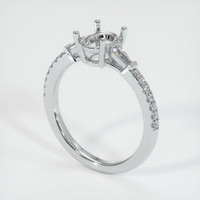
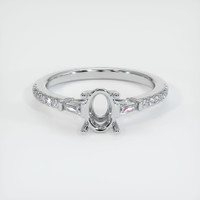
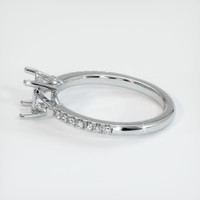
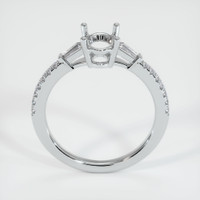


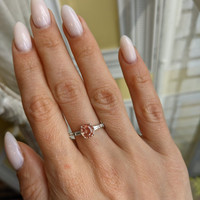
14K White Gold Three Stone Ring Setting


This custom made ring setting is designed to accommodate a single prominent center gemstone such as a sapphire, ruby, emerald or other fine gemstone, while combining a three stone composition with pavé set accent stones along the shoulders. The setting is offered in a full range of precious metals including rose gold, white gold, yellow gold, platinum, and a two tone yellow and white option, allowing subtle variation in warm or cool reflections to complement the chosen center gem. The three stone design positions the center gemstone as the focal point, flanked by four tapered baguette side stones that provide linear contrast and directional light return. Micro pavé or bead set melee stones are arranged on the top half of the band to create a continuous field of scintillation, producing a seamless and elegant look that reads as a single ribbon of sparkle from the finger. The combination of tapered baguettes and pavé melee produces a refined architectural profile that is versatile for oval, round or cushion center shapes, and the custom nature of the piece permits metal choice and finishing to be matched precisely to the hue and saturation of the center stone.
Pavé setting refers to the technique where multiple small gemstones are set closely together in a row or field, their edges nearly touching, and secured by tiny bead or micro prongs carved from the surrounding metal. This close setting reduces visible metal and creates a continuous surface of light return, therefore the visual effect is one of seamless brilliance, especially when high quality round brilliant melee diamonds are used, typically graded around G H color and SI clarity for optimal value to maintain near colorless appearance under normal viewing distance. The three stone style is a classical configuration symbolizing past, present and future, and from a gemological standpoint it also serves to balance optical weight and color contrast. The four tapered baguette side stones function as step cut elements, they emphasize linearity and create a visual channel that guides the eye to the center, they also introduce a different type of light performance, offering broad flashes that complement the scintillation of the pavé. When specifying the center gemstone, an educated buyer will consider origin and treatment, because these factors materially affect rarity and price. Fine sapphires and rubies are corundum and rate 9 on the Mohs hardness scale, making them excellent for everyday wear, and top origins such as Kashmir, Burmese Burma and Sri Lanka Ceylon command premium prices for their rare color saturation. Emeralds are members of the beryl family and typically show characteristic inclusions and fissures, which often leads to oiling treatments to improve clarity, and top Colombian and Zambian emeralds are valued for their color and transparency. Certification from recognized laboratories such as GIA, AGL or SSEF is recommended to document treatments, clarity characteristics and origin claims.
This ring setting has been engineered to enhance both the security and the optical performance of the center stone. The center head is a robust prong basket that combines vertical prongs with a supportive under gallery, the prongs capture the crown and girdle while the basket supports the pavilion. Reinforced shoulders and tapered seats for the baguette stones reduce lateral stress at the junction between head and shank, which increases retention security for the center gem during daily wear. The tapered baguettes are mounted with close fitting channels or low profile bezels that stabilize their long edges, preventing rotation and protecting corners, while the pavé melee are set with careful bead work and proper seat depth so they remain secure without obscuring light. Optically, the open basket and under gallery have been designed to maximize light entry from beneath the crown while the tapered shoulders and baguette facets reflect light back into the center stone, producing a perceived increase in brilliance and color intensity. Choice of metal affects both security and visual outcome, because platinum provides superior tensile strength and wear resistance for prongs and settings, while rose and yellow gold offer warmer reflective undertones that can enhance red and yellow gem hues, and rhodium plating on white gold will yield a bright white backdrop for diamonds if a cool aesthetic is preferred.
For the informed buyer this setting represents a high value proposition because it marries considered gemological principles with precision fabrication. Selecting a center stone with documented origin, minimal but disclosed treatments, and appropriate clarity and cut will ensure optical performance and resale transparency. For sapphires and rubies, prioritize strong even saturation and a well proportioned cut to optimize brilliance, and for emeralds consider slightly higher clarity grade or documented stabilization to reduce the likelihood of fracture during setting. The pavé melee can be specified to match color and clarity to suit a conservative or a premium budget, and the tapered baguettes are best selected with cut and length proportions that harmonize with the center gem footprint to avoid optical imbalance. Routine maintenance recommendations include periodic prong inspection, professional cleaning and reflowing of bead work on pavé every few years depending on wear, and re rhodiuming of white gold when luster diminishes. Custom options allow for adjustments in prong count and height for additional protection, or conversion to a partial bezel for emeralds that require extra security. This ring setting therefore offers an elegant, secure and technically informed platform for a meaningful three stone composition, combining pavé brilliance and tapered baguette structure to deliver refined sparkle and long term durability for the discerning buyer.

