
- Stone10
- Reports2
-rough-bicolor-crystal-11.9100-cts-s11452-1.jpg?d=200x200&v=20240213071311)
-rough-bicolor-crystal-11.9100-cts-s11452-lifestyleimage-1.jpg?d=200x200&v=20240215033219)
-rough-bicolor-crystal-11.9100-cts-s11452-lifestyleimage-2.jpg?d=200x200&v=20240215033219)


-rough-bicolor-crystal-11.9100-cts-s11452-1.jpg?d=750x750&s=nsc&v=20240213071311)
-rough-bicolor-crystal-11.9100-cts-s11452-lifestyleimage-1.jpg?d=750x750&s=nsc&v=20240215033219)
-rough-bicolor-crystal-11.9100-cts-s11452-lifestyleimage-2.jpg?d=750x750&s=nsc&v=20240215033219)


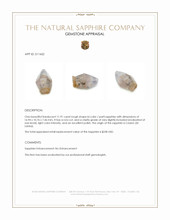
11.91 Ct. Bi Color / Parti Rough Sapphire from Ceylon (Sri Lanka)
This loose stone is available to ship now
Item ID: | S11452 |
|---|---|
Dimensions (MM): help | Length: 16.94 Width: 10.76 Height: 7.46 |
Weight: | 11.91 Ct. |
Color: help | Bi Color / Parti |
Color intensity: help | Light |
Clarity: help | Very Slightly Included |
Shape: help | Rough |
Cut: | N/A |
Cutting style: | N/A |
Enhancements: help | No Enhancement |
Origin: help | Ceylon (Sri Lanka) |
Per carat price: help | $20 |
This 11.91 carat translucent rough sapphire presents as a classic crystal form from Ceylon Sri Lanka, with dimensions of 16.94 by 10.76 by 7.46 millimeters, and a distinct bi color and parti character that will interest both cutters and collectors. The material is offered in its rough state, with no enhancement, and with an excellent polish on visible termination faces, a condition that demonstrates careful recovery and handling at source. At eye level the clarity is graded as very slightly included, indicating that minor natural features are present but do not significantly detract from the overall visual appeal, and these internal characteristics can be used advantageously during planning to orient the piece for color zoning or to retain weight. The Natural Sapphire Company provides this specimen with full provenance from Ceylon Sri Lanka, a locality renowned for producing sapphires with delicate color palettes, and the combination of light color intensity and parti distribution in this crystal makes it a rare candidate for bespoke cutting approaches or for retention as a collector crystal.
Optical and internal features are clearly relevant to any technical assessment, the crystal displays translucent light transmission with discrete zones of differing hue, and the parti nature suggests at least two dominant color components separated by growth zoning rather than diffusion. Under standard observation conditions the piece shows pleochroic tendencies, with variations in tone and saturation when viewed along different crystallographic directions, a property that can be exploited by selective orientation in faceting to maximize either contrast or uniformity. The noted very slightly included clarity grade, evaluated at eye level, implies that features such as fine rutile needles, pinpoint crystals, or thin healed fissures may be present, these inclusions are typically stable and do not require fracture filling, which aligns with the unenhanced status of the material. The excellent polish on the natural terminations and on any exposed facets facilitates detailed mapping and photodocumentation, enabling precise planning for cut recovery and yield estimates.
From a cutting and planning perspective the rough profile and internal zoning define the primary options, the elongated habit and the distribution of parti color suggest that oriented cuts which preserve length will best display the dichroic color separation, while retaining substantial weight. Candidates for maximizing aesthetic and market value include elongated brilliant cuts with a mixed pavilion to enhance face up color, step cuts that emphasize color bands and clarity, or freeform pavilion adjustments to preserve unique zoning patterns. For designers interested in soft diffusion of hue, polished cabochons can create a serene wash of color that harmonizes the parti tones, particularly given the light color intensity and translucency of this crystal. The cutting tradeoffs are predictable, more aggressive cutting to achieve higher brilliance will reduce carat weight and may blend the parti colors, while conservative trimming will retain weight and stronger color partitioning, therefore the optimal strategy depends on whether the priority is face up color separation, maximum finished size, or inclusion aesthetics. Skilled cutters can use the existing termination surfaces as orientation guides to align pavilion facets with optical axes, minimizing windowing and optimizing light return.
As a presentation from The Natural Sapphire Company this rough sapphire is positioned for specialists seeking material with natural parti character and documented origin, the Ceylon provenance carries both gemological and market significance, and the absence of enhancement supports long term value and stability. For collectors the crystal in its current rough form offers the intrinsic appeal of natural growth features, and for cutters and bespoke jewellery designers the stone offers multiple pathways for transformation subject to individual design priorities, our team can provide full planning services including high resolution mapping, yield simulation, and cutting proposals that quantify retained weight and expected optical results. Care recommendations for handling and mounting are consistent with corundum properties, the material is durable under normal wear but should be protected from hard knocks during setting operations, and any lapidary work should be performed by practitioners experienced with parti sapphires to preserve the best combination of color and weight. Please contact The Natural Sapphire Company for further technical documentation, condition photos, or to discuss custom cutting and finishing options, we welcome technical inquiries and can coordinate next steps to realize the full potential of this distinctive Ceylon bi color sapphire.


