
- Stone11
- Reports3




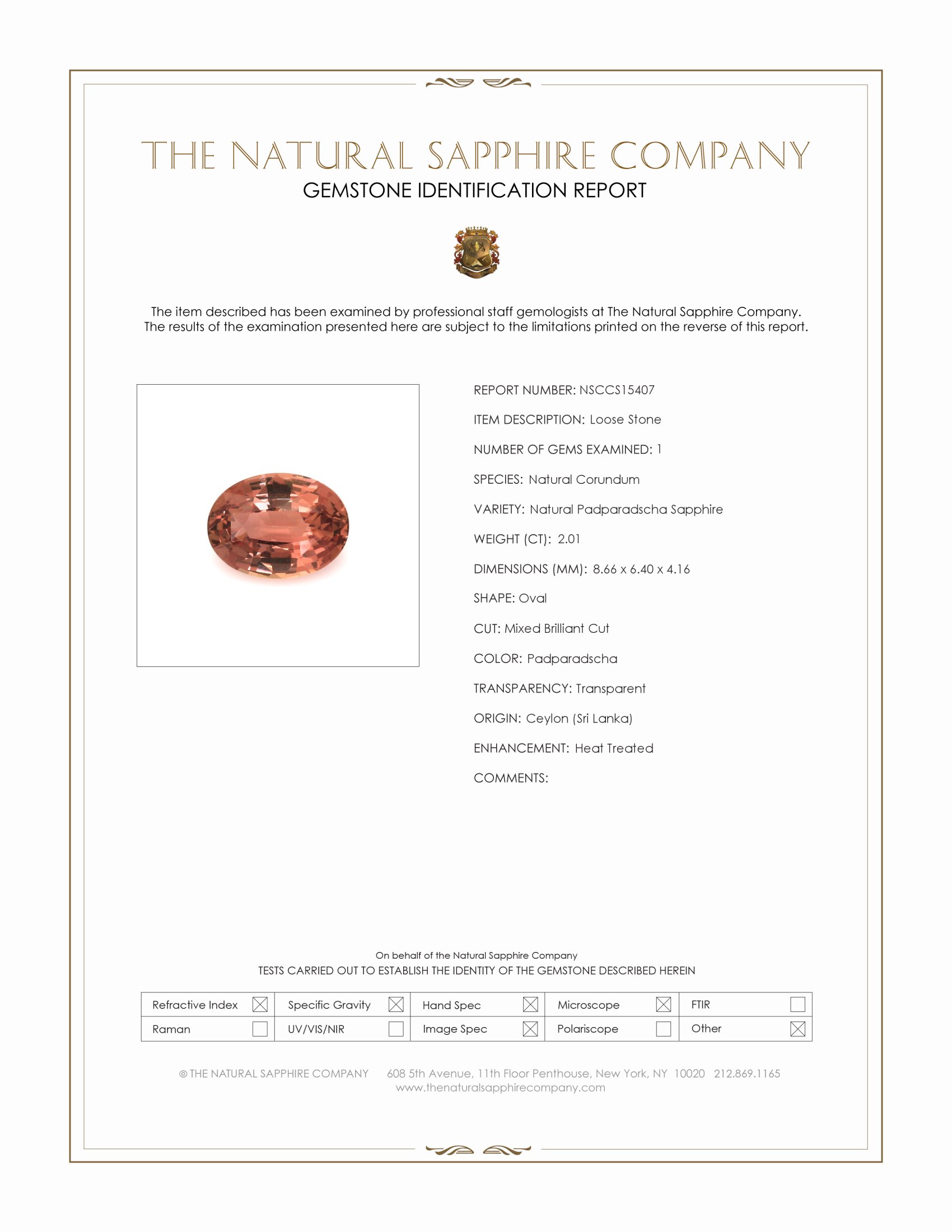
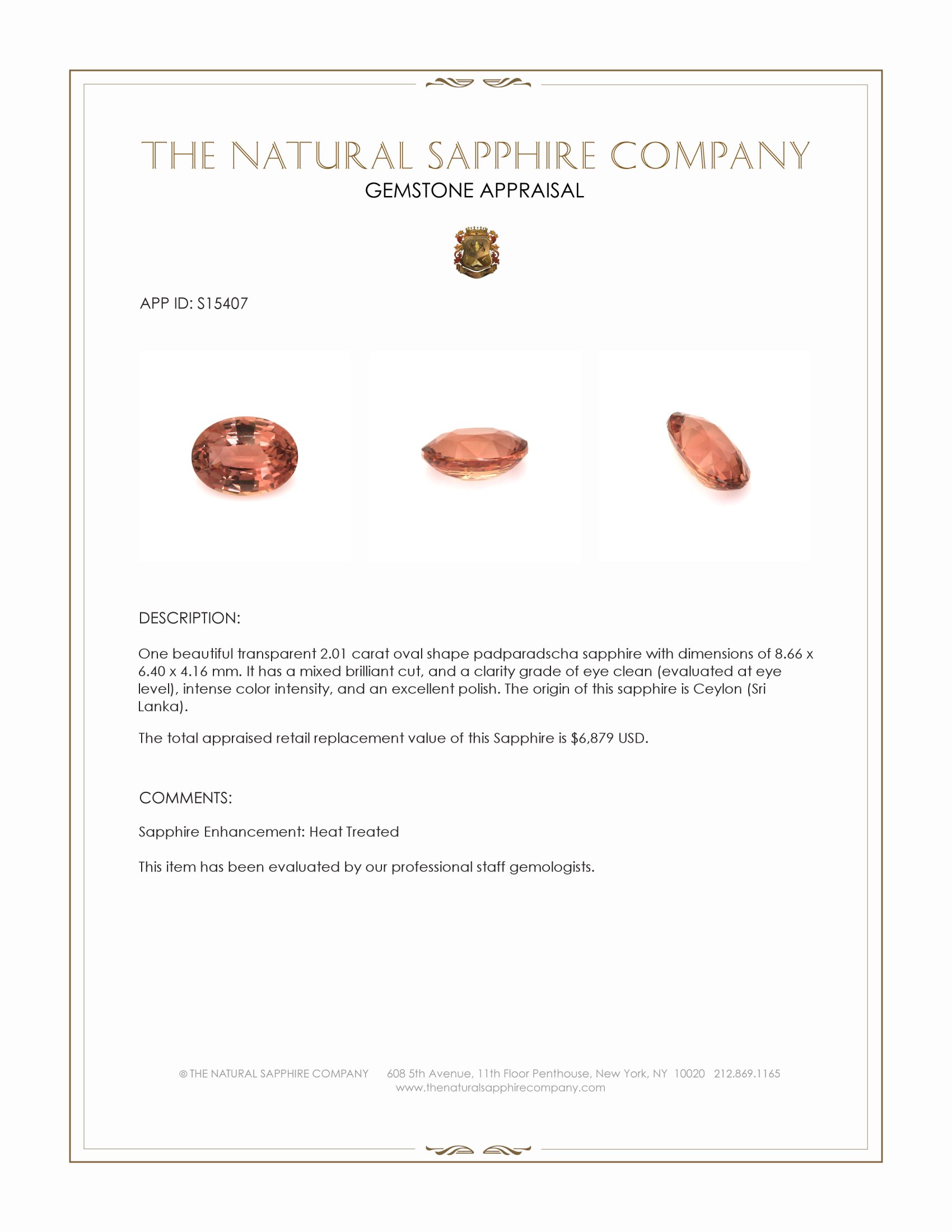
2.01 Ct. Padparadscha Sapphire from Ceylon (Sri Lanka)
This loose stone is available to ship now
Item ID: | S15407 |
|---|---|
Dimensions (MM): help | Length: 8.66 Width: 6.4 Height: 4.16 |
Weight: | 2.01 Ct. |
Color: help | Padparadscha |
Color intensity: help | Intense |
Clarity: help | Eye Clean |
Shape: help | Oval |
Cut: | Mixed Brilliant Cut |
Cutting style: | Faceted |
Enhancements: help | Heat Treated |
Origin: help | Ceylon (Sri Lanka) |
Per carat price: help | $3,422 |
This 2.01 carat oval padparadscha sapphire measures 8.66 x 6.40 x 4.16 mm, and it embodies a refined balance of hue, clarity, and cutting precision. Cut in a faceted mixed brilliant style, the cutter has oriented the table and pavilion to maximize face up color and return of light, while maintaining an oval outline that optimizes visual spread relative to carat weight. The stone is eye clean as evaluated at eye level, exhibiting no inclusions that interrupt the field of view, and it carries an intense color intensity, delivering a vivid, saturated padparadscha tone. The polish is graded excellent, resulting in crisp facet junctions and mirror like facet surfaces. The sapphire has been heat treated, a stable and widely accepted enhancement applied to improve color consistency and clarity, and the origin is Ceylon Sri Lanka, a source renowned for producing padparadscha material with the characteristic salmon pink to orange interface that defines the variety. The Natural Sapphire Company presents this gem with emphasis on its technical attributes and suitability for precision jewelry design.
The mixed brilliant cutting style employed here is chosen to reconcile two competing optical priorities in a colored corundum specimen, light return and color saturation. On a stone with corundum refractive index, the cutter must calibrate crown and pavilion geometry so that the path of light through the stone enhances wavelength selective absorption rather than simply maximizing white light scintillation. The mixed brilliant approach achieves this by combining a brilliant facet layout on the crown that produces lively scintillation and small flashes of light, with a modified pavilion geometry that controls windowing and preserves depth of color. The result is a gemstone that presents strong, even face up color while delivering controlled brilliance and scintillation. Compared to diamonds which have a markedly higher refractive index and dispersion, this padparadscha will not exhibit the same level of fiery flash or spectral fire, because diamonds rely on dispersion to create colorful flashes. Compared to more common sapphires and rubies, which are also corundum and therefore similar in refractive behavior, this padparadscha stands out because its hue and saturation alter the perception of brilliance. The intense pink orange hue absorbs selectively across the spectrum so that light return is perceived as a warm, luminous glow rather than the stark white sparkle often associated with colorless stones. Compared to emerald, whose brilliance is often diminished by abundant inclusions, and compared to typical blue sapphires, which can appear deeper and therefore less lively, this padparadscha balances color saturation with surface lustre to create an appearance that is both luminous and richly colored.
From the perspective of jewelry manufacture and end use, this 2.01 carat oval padparadscha is particularly well suited as a center stone in settings that allow significant light interaction, such as prong mounted rings, open gallery pendants, or four prong solitaire earrings. The oval shape and mixed brilliant faceting encourage a visual length that enhances apparent size and provides even color distribution across the table. When setting the stone the cutter orientation should be respected so that any subtle pleochroic tendencies present in corundum are aligned to present the most desirable hue face up. The heat treatment applied is permanent under normal wear conditions, and routine care consists of gentle cleaning with warm soapy water and a soft brush, avoiding harsh ultrasonic treatments when inclusions are unknown. For clients who favor protective settings, a bezel will secure the gem but will slightly reduce light throughput and the perceived brilliance, whereas a low profile prong setting will maximize light return and display. The Natural Sapphire Company offers this padparadscha with full technical documentation upon request, and we can advise on bespoke mounting options that respect the stone geometry and optical orientation, ensuring that the final piece showcases the intense color intensity, excellent polish, and precise mixed brilliant faceting to greatest advantage.


