


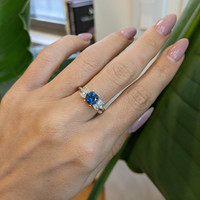
Silver Accent Stones Ring Setting


This custom made ring setting brings a classic accent stones composition to a refined modern execution, where smaller gemstones are carefully set around the center stone to frame it, to increase perceived size, and to add dynamic sparkle from every angle. The setting is offered in a comprehensive range of metals including 14K rose gold, 18K rose gold, 10K yellow gold, 14K white gold, 18K white gold, 10K white gold, 14K yellow gold, 18K yellow gold, platinum 950, silver, and two tone configurations such as 14K white and yellow, 18K white and yellow, 14K yellow and white, and 18K yellow and white, so the color of the metal can be chosen to optimize contrast and warmth against your selected center gem. The design accommodates classic gem species including sapphire, ruby, emerald, or other fine gemstones, and it is configured to carry side stones in a balanced arrangement of four marquise shaped stones and four pear shaped stones, arrayed symmetrically in two clusters flanking the center. The marquise cuts elongate the profile and guide the eye toward the center, while the pear shapes introduce gentle curves and scintillation, so the ensemble functions as an optical amplifier for the central stone. For an educated buyer this is not decoration alone, it is an engineered optical system, where cut angles, facet alignment, and metal finish are coordinated to maximize return of light, minimize glare, and preserve daily wearability.
When selecting a center stone, understanding grading, clarity, and origin is essential, because these factors determine both aesthetic quality and long term value. Sapphires and rubies belong to the corundum family, they rate nine on the Mohs hardness scale, and they respond exceptionally well to fine cuts that reveal saturated color and high clarity, with heat treatment commonly disclosed to improve tone and remove silk. Emeralds typically show natural inclusions and fissures, they are softer relative to corundum with typical hardness around seven and a half to eight, and they are commonly oiled or filled to enhance apparent clarity, so clarity expectations should be adjusted accordingly, and treatment disclosures are critical. Color sourcing matters too, because provenance such as Kashmir, Sri Lanka, or Madagascar for sapphires, Burma or Mozambique for rubies, and Colombia, Zambia, or Brazil for emeralds can affect hue saturation and market perception. For side stones, especially marquise and pear shapes, precise symmetry and good girdle integrity are vital because pointed ends are susceptible to chipping, so we recommend IF to VS grades for high brilliance accents when diamond alternatives are used, or for colored gemstone accents, selecting stones with even color saturation and minimal surface-reaching fractures. We strongly advise certified grading for the center stone from reputable labs such as GIA or AGL, because certificates document cut proportions, color grading, clarity observations, and any treatments or enhancements, giving the informed buyer the data needed to evaluate both beauty and investment potential.
The process of designing and refining this ring setting is meticulous and iterative, blending modern CAD workflows with traditional handcraftsmanship to ensure both elegance and function. We begin with a consult to determine center stone choice, carat size, and desired metal, then create multiple CAD renders to study proportions and light behavior, focusing on prong geometry that secures the center while allowing maximum crown exposure for brilliance. The marquise and pear side stones are modeled with particular attention to the angles of their points and the setting seats, so that prongs are placed to protect vulnerable tips and to leave pavilion facets free to reflect light. From CAD we produce a high resolution 3D print and a wax prototype to confirm comfort of the shank, the profile height, and the interplay of side stones with the center. Castings are finished by hand, with precise filing to create clean undergallery structure that both lightens the overall weight and distributes stress, then seats are formed and inspected under loupe magnification to ensure each stone will sit flush and secure. Stones are set by master setters who control torque and pressure to avoid fissures, then burnishing and polishing sequences are applied to the metal, and for white gold options a rhodium plating is available to enhance whiteness and scratch resistance. Final quality control includes magnified inspection for stone tightness, a wear test to confirm prong stability, and professional measurements to ensure the ring meets the agreed specifications. The result is a ring setting that combines certified gemstone standards, a carefully considered accent stone layout of four marquise and four pear stones, and engineering to preserve beauty under daily wear, offering educated buyers a transparent presentation of grading, origin, and workmanship, and a lasting piece suitable for both investment and lifelong enjoyment.

