
The Legendary Kashmir Sapphires
Kashmir sapphires are blue sapphires from a small, remote deposit high in the Himalayas, above the village of Sumjam in the Padar region of Kashmir, India. They were discovered around 1881, when a landslide exposed sapphire-bearing rock. The richest deposit was worked for only a few years and was largely exhausted by 1887. Fine Kashmir sapphires are famous for an intense, velvety cornflower blue that stays beautiful in any light. Because so little was ever mined and almost no new material appears, they are among the rarest and most coveted sapphires in the world.
Their story combines a remote mountain discovery, a remarkably short period of productive mining, and a supply that effectively ended more than a century ago.
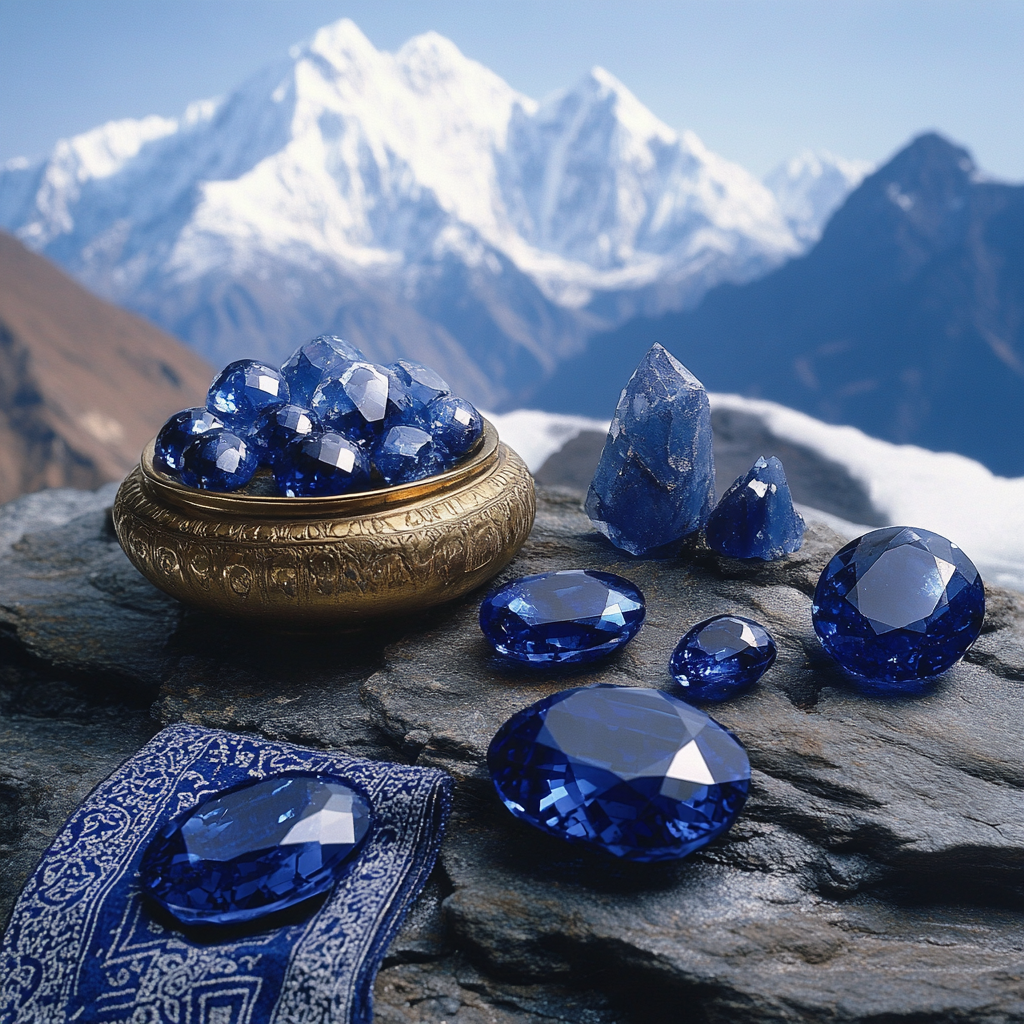
The Accidental Discovery of Kashmir Sapphires
Around 1881, a landslide high in the mountains of Kashmir’s Padar region exposed blue crystals above the village of Sumjam. Local people began collecting the stones, and traders carried some of them across the mountains to Shimla, where their true value was recognized.
Once their importance was clear, the Maharaja of Kashmir sent guards to protect the area, and by 1882 the deposit was under state control. The richest pocket, later known as the “Old Mine,” produced sapphires of extraordinary quality, but it was small. By 1887 it was largely exhausted.
That same year, T. D. La Touche of the Geological Survey of India surveyed the area and wrote the first detailed account of the mines. The site sits at roughly 4,500 meters (about 14,800 feet), where snow closes access for much of the year. Later attempts to work the area produced only small, irregular amounts. You can read more of this history in our earlier article, History of Kashmir Sapphires.
What Makes Kashmir Sapphires So Special?
The defining feature of a fine Kashmir sapphire is its color: an intense yet softly balanced blue, often called cornflower blue. Even more distinctive is its velvety appearance. Extremely fine inclusions scatter light
throughout the stone and spread the color evenly, so the blue looks soft and glowing rather than dark or glassy. In exceptional examples, the color stays rich in daylight, candlelight, and indoor lighting alike. To learn how these tiny features form, see our guide to the secrets inside a sapphire.
Not every sapphire from Kashmir looks the same, however. As with any origin, individual stones vary considerably in quality.
Why Are Kashmir Sapphires So Rare?
Their rarity comes down to a simple problem: the source produced exceptional material for only
a few years.
The deposit is extremely remote, cut off by snow and harsh weather for much of the year, and the richest material was depleted quickly. Unlike sources such as Sri Lanka or Madagascar, which still supply the market, Kashmir produces almost no new gem material.
Most important Kashmir sapphires on the market today therefore come from old jewelry, private collections, estates, and auctions. Demand stays strong while the supply of documented stones remains extremely limited.
Can You Identify a Kashmir Sapphire by Color Alone?
No. A beautiful velvety blue sapphire should never be called “Kashmir” just because it looks like one.
Determining origin requires detailed gemological testing. Laboratories study microscopic inclusions, growth features, trace-element chemistry, spectroscopy, and other characteristics before giving an opinion. For any valuable sapphire described as Kashmir origin, a report from a respected independent laboratory is essential. Our article Do Sapphire Origins Matter? explains how origin affects value.
Kashmir vs. Ceylon and Burmese Sapphires
Kashmir, Sri Lanka, and Myanmar have all produced exceptional blue sapphires, and each is often linked with a slightly different look.
Kashmir sapphires are celebrated for their velvety blue. Fine Ceylon sapphires from Sri Lanka are admired for bright, lively blues and excellent transparency, as in the famous Blue Belle of Asia. Burmese sapphires can show deep, highly saturated blues.
These descriptions are tendencies, not rules. Origin alone does not determine beauty or value,
and an exceptional Sri Lankan or Burmese sapphire may be far more desirable than a lesser
stone from Kashmir.
Why Collectors Pay So Much for Kashmir Sapphires
For serious collectors, a Kashmir sapphire offers a combination that is almost impossible to repeat: beauty, rarity, provenance, history, and a supply that is effectively closed.
Fine examples, especially larger stones with strong laboratory documentation and no evidence of heating, have achieved remarkable auction results. One example is covered in our article on a record-setting Kashmir sapphire at Christie’s. Because collectors cannot wait for new Kashmir material, each important historic stone that resurfaces becomes an event in the gem world.
Are All Kashmir Sapphires Untreated?
No. Kashmir origin and treatment status are two separate characteristics.
Some sapphires may have been heated to improve their appearance, while others show no evidence of heat treatment. For collectors, an exceptional Kashmir sapphire accompanied by a laboratory report indicating no evidence of heating can carry an additional premium.
This is another reason laboratory documentation matters when purchasing historically significant sapphires.
A Gemstone Born from a Brief Moment in History
The extraordinary reputation of Kashmir sapphires comes from something that lasted only a few years. A remote Himalayan deposit produced some of the most celebrated blue sapphires ever found, then its richest material was exhausted. More than a century later, these stones still move between important collections, historic jewelry, and international auctions.
For sapphire lovers, Kashmir sapphires are more than a prestigious origin. They are survivors of a remarkable chapter in gemstone history: a geological accident, extraordinary beauty, and a scarcity that may never be repeated.
Experience the legendary beauty of Kashmir sapphires for yourself. Visit our collection HERE and
discover these extraordinary blue gems.